Paper table tents cost roughly $0.15 to print. They also cost venues thousands of dollars a month in missed upsell revenue — not because the format is wrong, but because guests stop reading them after the second or third visit.
TL;DR
Paper table tents stop working after 2–3 visits due to familiarity blindness. Digital table tents with real-time content — happy hour countdowns, hotel cross-sells, time-sensitive offers — increase average order value by 18%. At 100 covers/day and a $35 average check, that translates to an additional $18,900/month at full promotional capacity.
The Upsell Problem: Why Paper Table Tents Stop Working
When a guest sees the same folded card on the same table during every visit, their brain categorizes it as ambient furniture and filters it out. This effect, sometimes called "banner blindness" in digital contexts, applies just as directly to physical collateral.
A 40-table venue reprinting seasonal table tents quarterly spends $400–$800 per year on print production alone. More critically, paper cannot react to real-time conditions: it cannot show a countdown, display current availability, or adapt messaging based on the time of day.
Digital table tents solve this at the unit level. Each display operates as an independently scheduled content channel that can be updated in 30 seconds via cloud CMS.
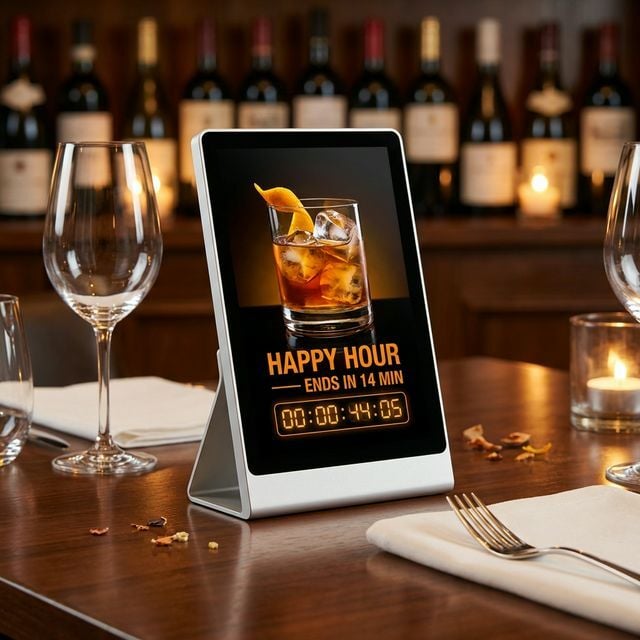
Bar Happy Hour: How Countdown Timers Drive Impulse Orders
A countdown timer — "Happy hour ends in 23 minutes" — activates loss aversion. The guest sees a number ticking down and the cognitive cost of ordering shifts from "should I bother?" to "what should I get?"
The effect is strongest in the final 15 minutes of a promotional window. At $950 per unit with a $30/month CMS subscription covering unlimited screens, a venue operating 20 tables can run time-triggered content across all of them simultaneously, with happy hour countdowns switching automatically to late-night cocktail promotions at 7:01 PM without any staff involvement.
Rendered image
Hotel Bar and Restaurant: Cross-Property Revenue
For hotel F&B operations, a guest eating dinner is already on property, already spending, and likely to respond to ancillary offers — but only if exposed to them. Staff upsell conversion rates typically run 15–20%, which depends entirely on whether the server remembered to mention it.
A WiFi-connected digital table tent runs a spa promotion at dinner without requiring any staff interaction. It shows remaining spa appointments with a room charge option. It promotes a rooftop event with a scannable QR code. Each cross-sell touchpoint exists independently of the service encounter.
The 15.6" 1920x1080 touchscreen format (10-point multitouch, 3.2kg aluminum body, Android 7.0+) makes it practical for guests to interact directly — the guest is self-selecting the upsell.
Casino and Entertainment Venues: Time-Sensitive Offers
In casino and entertainment environments, the highest-converting table content is time-specific rather than product-specific. A countdown to VIP seat availability — "Tonight's headline act starts in 45 minutes — 12 VIP seats remaining" — combines scarcity with time pressure.
SeenLabs units support optional AI-powered audience analytics through an integrated edge AI camera module (Sony AITRIOS IMX500). The camera performs on-device inference to detect viewer demographics and measure attention duration — no cloud processing, no video storage, no personally identifiable data leaves the device.
Measuring ROI: Tracking Upsell Revenue Lift
The measured average lift is +18% AOV. The math for a mid-volume venue at full promotional capacity:
| Metric |
Baseline |
With Digital Table Tent |
| Average check per cover |
$35.00 |
$41.30 (+18%) |
| Covers per day (100-table venue) |
100 |
100 |
| Additional daily revenue |
— |
$630 |
| Additional monthly revenue |
— |
$18,900 |
| Payback period |
— |
Under 3 days |
The ongoing cost is $30/month for unlimited screens. A practical sequencing approach: deploy first in the highest-AOV section (typically bar seating), measure for 60 days, then expand to the full venue.
Frequently Asked Questions
How long does it take to set up a digital table tent in a venue?
Each unit takes approximately 15 minutes to set up, including mounting, power connection, and initial CMS pairing. For a venue deploying 20 units, a single technician can complete the installation in half a day.
Can we update content during service without disrupting guests?
Yes. Content updates push via cloud CMS and take 30 seconds to propagate. The display transitions smoothly to new content without any interruption.
What is the minimum order quantity and CMS pricing?
The minimum order is 2 units at $950 each. CMS is $30/month for unlimited screens — a venue that scales from 2 to 40 units pays the same monthly fee.
Do digital table tents work in venues with low lighting?
Yes. Brightness and contrast can be adjusted per venue through the CMS. The screen's visibility in dim bar lighting is significantly higher than paper collateral, which reads poorly without direct lighting.
How do we know the AOV lift is coming from the displays?
Deploy displays in one section and keep another as a control, holding all other variables constant. Measure AOV per section over 60–90 days. This eliminates seasonal confounds and gives a clean lift number attributable specifically to the display content.