Running a rooftop LED advertising fleet is a media ownership business, not a vehicle business. That distinction changes everything about how you price, sell, and scale it.
TL;DR
A car rooftop LED advertising business works by selling 5-second ad slots in a 60-second content loop. At 11 slots per vehicle and $300/slot/month, one vehicle generates $3,300/month gross at full advertiser capacity. Hardware costs $4,300 (P2.5 unit + mount). Break-even: under 2 months when fully sold. Minimum viable fleet: 10 vehicles to attract local advertisers at scale.
What Is the Car Rooftop LED Advertising Business Model
There are two ways to enter this market, and they have different economics, risk profiles, and growth ceilings.
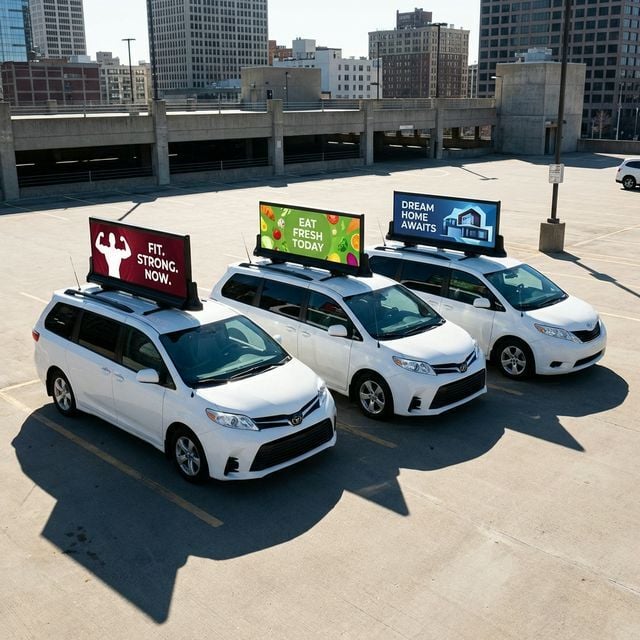
The media owner model means you own or lease vehicles, install LED displays on them, and sell advertising inventory to local businesses. You control the entire stack: hardware, content scheduling, advertiser relationships, and billing. Revenue scales with the number of vehicles and the fill rate of your advertiser slots. This is the higher-return path into the out-of-home advertising fleet business and the model this guide focuses on.
The fleet partner model means you install displays on vehicles you do not own (taxis, rideshare cars, delivery vans, corporate fleets) and split advertising revenue with the vehicle operator. This is the taxi advertising business variant: your capital outlay is the same (you still buy the hardware), but you get an existing route network without building it yourself. The tradeoff is a revenue share, typically 30 to 50 percent to the vehicle operator, which compresses your margins but accelerates coverage.
Both models use the same underlying infrastructure: double-sided LED displays mounted to vehicle rooftops, managed remotely through a cloud CMS, selling time-sliced advertising inventory on a monthly subscription basis to local advertisers.
How Much Can You Earn Per Vehicle Per Month
The revenue model runs on a 60-second content loop. Five seconds of that loop are reserved for operator self-promotion or house ads, leaving 55 seconds of sellable inventory. At 5 seconds per advertiser slot, each vehicle carries 11 advertiser slots.
At a rate of $300 per slot per month, a fully sold vehicle generates $3,300 in gross monthly revenue. A vehicle operating 10 hours per day completes 60 content loops per hour, delivering 18,000 local impressions per month per slot. At $300, the effective CPM works out to $16.67.
Rendered image
$33,000/mo
gross revenue from 10-vehicle fleet at full capacity
One vehicle alone will not attract serious advertisers. The minimum viable fleet for advertiser sales is 10 vehicles in a single market. At 10 vehicles fully sold, gross monthly revenue is $33,000. Be realistic with yourself about ramp time. Reaching full capacity on 10 vehicles — 110 advertiser slots sold — takes 60 to 90 days of active sales effort in a new market.
Startup Costs: Hardware, CMS, Permits, and Insurance
The car rooftop LED display from SeenLabs is a double-sided unit measuring 960x320mm per side, rated at 4,500+ nits brightness for full daylight visibility, and built to IP66 weatherproof standard. It runs on 12V or 24V DC from the vehicle's existing electrical system and includes 4G, WiFi, and GPS natively. Installation runs approximately two hours per vehicle.
| Configuration |
Unit Cost |
Mounting Kit |
Total / Vehicle |
10-Vehicle Fleet |
| P2.5 |
$3,950 |
$350 |
$4,300 |
$43,000 |
| P2 |
$4,950 |
$350 |
$5,300 |
$53,000 |
| P1.6 |
$5,450 |
$350 |
$5,800 |
$58,000 |
Software cost is not a significant line item. The TaxiHub cloud CMS covers unlimited screens for $30 per month, which means your software cost per vehicle drops as you add vehicles. At 10 vehicles, CMS cost is $3 per vehicle per month.
Commercial auto insurance is more variable. Expect an additional rider of $50 to $150 per vehicle per month depending on state, vehicle type, and carrier.
How to Sign Advertiser Clients for Your Fleet Network
Your primary targets are local businesses with geographic marketing needs: restaurants, gyms, retail stores, real estate agents, event venues, medical clinics, and auto dealers. These are businesses that buy outdoor advertising, value neighborhood reach, and have budgets in the $200 to $500 per month range.
The sales pitch is built around one number: 18,000 local impressions per month for $300. Compare it directly to what $300 buys on Google: clicks from anywhere in a metro area, served to users with no confirmed proximity to the business location. A rooftop fleet slot guarantees every impression happens on the street, in the neighborhood.
For a fleet of 10 vehicles, the network pitch becomes stronger: 180,000 local impressions per month for $300 — one slot across the full fleet rather than one vehicle.
Start with two to three anchor clients before pitching the full inventory. Contract terms for a new network should be short — 30 to 60 days — to lower the commitment barrier.
Regulations and City Permits
Regulation of vehicle-mounted digital advertising varies significantly by city and state. Some cities treat a rooftop billboard vehicle as a mobile billboard and require a DOOH vehicle permit. Fees range from $0 to $500 per vehicle per year depending on the municipality.
Points to verify with your city's transportation or zoning department before launching: whether mobile digital signage requires a permit, whether there are brightness or operating-hour restrictions (some cities limit display brightness after 10pm), and whether your state's distracted driving statutes create any liability exposure for moving digital displays.
Frequently Asked Questions
How many vehicles do I need to start a rooftop LED advertising business?
Ten vehicles operating in a single city is the practical minimum to attract advertisers. A 10-vehicle fleet at full advertiser capacity generates $33,000 per month in gross advertising revenue against roughly $43,000 in hardware investment at the P2.5 configuration.
What type of local businesses make the best first advertiser clients?
Restaurants, gyms, retail stores, and real estate agents are the easiest early targets because they already buy local advertising, understand CPM pricing, and have budgets in the $200 to $500 per month range.
How long does it take to break even on a 10-vehicle rooftop LED fleet?
At full advertiser capacity, hardware costs ($43,000) are recovered in approximately six weeks. At a more realistic starting fill rate of 50%, break-even extends to around three months.
Do I need a special business license to sell advertising on vehicle-mounted displays?
Licensing requirements vary by city and state. Most jurisdictions require a general business license, and some cities require a specific DOOH vehicle permit for mobile advertising displays. Check with your local transportation or zoning department before launching.
Can the LED display run from the vehicle battery without draining it?
The SeenLabs unit draws power from the vehicle's 12V or 24V DC electrical system and is designed to operate in line with normal vehicle use. For fleets with extended idle time, operators typically configure the display to enter sleep mode when the engine is off.