Based on operator-reported outcomes from 500+ SeenLabs deployments, restaurants see an 18% average increase in order value when they replace static printed cards with digital table tent displays — because the menu stops working the moment the server walks away, and most restaurants have no upsell tool that fills that gap. Both digital table tents and QR code menus try to solve that — but they solve different problems, for different restaurants, with different tradeoffs.
TL;DR
QR code menus cost almost nothing but rely on guest action — scan rates top out at 40–60% and drop further with older demographics. Digital table tents display upsell content passively, with no guest action required. Restaurants see an average 18% increase in order value. Over 3 years, the math favors digital for any restaurant focused on revenue, not just cost-cutting.
What Each Solution Actually Does
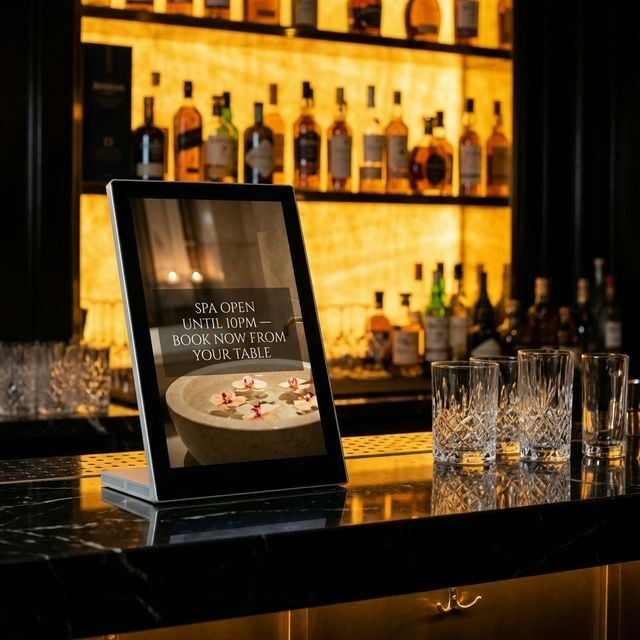
A digital table tent is a commercial-grade touchscreen display placed on a restaurant table to show menus, promotions, and upsell content. The SeenLabs unit runs a 15.6-inch 1920x1080 touchscreen on Android, connected to a cloud CMS. Staff update content across all units in about 30 seconds. The screen runs on DC 12V power and weighs 3.2kg in an aluminum alloy frame.
A QR code menu is a printed code that guests scan with their phone. Cost to launch is close to zero. The core functional difference: a QR menu requires the guest to take an action (scan, wait for load). A digital table tent requires nothing — it is always on, always visible, working passively between ordering rounds.
Rendered image
Revenue Impact: Upsell Data for Each Format
QR menu scan rates in casual dining land between 40–60%, and that number drops further with groups where one person orders for the table. The format works for browsing the full menu, but has almost no capability to surface targeted upsell prompts.
Digital table tents reach guests during the high-value gaps in a meal: after appetizers, while waiting for the main. Venues see an average +18% increase in order value (AOV) and +40% increase in product awareness for promoted items.
The math for a mid-size restaurant: 50 tables, $45 average check, 2.5 turns per day = roughly $2 million in annual revenue. An 18% AOV lift on even a fraction of those covers compounds quickly.
Guest Experience: Who Prefers What
A significant portion of older guests — particularly 55+ — either refuse or struggle with QR code menus. Phone-out behavior during a meal can also feel inconsistent with upscale-casual or fine-dining atmospheres.
Digital table tents are almost universally accepted because they require nothing from the guest. They function more like ambient signage than interactive technology.
SeenLabs units support optional AI-powered audience analytics through an integrated edge AI camera module (Sony AITRIOS IMX500). The camera performs on-device inference — no cloud processing, no video storage — to detect viewer demographics and measure attention duration. All processing happens locally on the sensor chip, so no personally identifiable data leaves the device.
Cost of Ownership Over 3 Years
Paper menus for 50 tables: laminated replacements at $0.50–$2 each, reprinted 2–4 times per year = $500 to $4,000 per year in print costs alone.
QR menus eliminate print costs almost entirely. Platform subscription runs $0–$100/month. For tight-budget operations, QR is the obvious call.
A digital table tent with cloud CMS carries a higher upfront investment: $950/unit, CMS at $30/month for unlimited screens. For 10 units over 3 years: $9,500 hardware + $1,080 CMS = $10,580 over three years, or about $3,527/year. Against a $2M revenue restaurant, that is 0.18% of revenue.
When QR Code Wins, When Digital Table Tent Wins
QR Code Wins When:
- Fast casual or counter-service
- Table turnover is the primary metric
- Guests skew under 40
- Budget is under $500
- Goal is simply replacing paper
Digital Table Tent Wins When:
- Full-service or upscale casual
- Alcohol and specials promotion matters
- Average check is above $35
- Hotels or bars with extended dwell time
- QR adoption is below 60%
The honest framework: QR is a cost-cutting tool. A digital table tent is a revenue tool. Both replace paper, but only one actively works to increase what guests spend.
Frequently Asked Questions
Can I use both a QR code and a digital table tent at the same time?
Yes. The digital table tent handles ambient upsell and promotions while the QR code gives guests who want to browse the full menu that option on their phone. They serve different moments in the dining experience and do not conflict.
How long does it take to update content across a whole restaurant?
With a cloud CMS, a content change pushes to all screens in about 30 seconds. No physical visit to each table, no USB drives, no reboots required.
Are digital table tents sanitary — guests have to touch them, right?
Most content runs passively without any guest input required. The touchscreen is available for interactive menus if enabled, but the display can function as a pure passive screen with no touch interaction.
What happens if the internet goes down?
SeenLabs units run on Android and store content locally after the initial sync. They continue displaying cached content during a connection outage, then auto-sync when connectivity is restored.
Do digital table tents work for bars where the lighting is dim?
The SeenLabs unit runs at 300 nits, which is appropriate for standard indoor restaurant and bar lighting. For dim bar settings, 300 nits is more than sufficient and avoids the overly bright screen effect that can disrupt ambiance.