Real estate agencies with street-level offices have a permanent billboard most never use well: the storefront window. A digital window display — a commercial-grade screen mounted behind storefront glass — turns that passive surface into a 24/7 property listing display that captures foot traffic with no staff involvement.
TL;DR
A real estate agency's storefront window is a 24/7 billboard — but only if the display works at night. Based on SeenLabs deployments, 30–40% of interactions happen after hours. Digital window displays update listings in minutes, show sold overlays and price drops in real time, and cost less over 3 years than recurring print. One closed walk-in deal ($5,000–$15,000 commission) covers the hardware cost.
How Real Estate Agencies Use Window Screens to Generate Walk-In Leads
30 to 40% of interactions with digital window displays occur outside business hours — evenings and weekends, which are peak browsing times for buyers. A static window card does nothing at 8pm on a Saturday when a couple is walking home and spots a neighborhood they like.
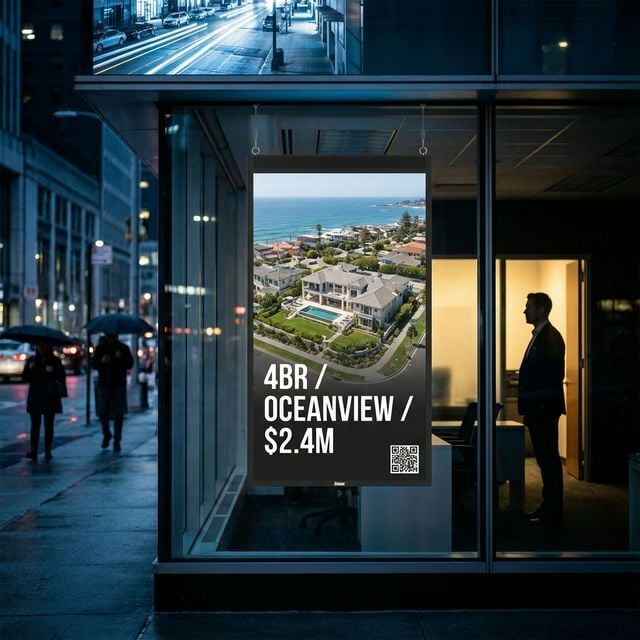
A digital window display runs continuously. A 55" or 65" commercial screen facing the street shows rotating listings, price drops, and sold overlays in full resolution. Passers-by stop, scan a QR code linking to a virtual tour, and walk in the next day with a specific property in mind.
MLS Feed Integration vs. Manual Content Updates
In the US, automated MLS feed integration is not yet a standard feature. SeenLabs window displays update content through a cloud-based CMS — you upload listing images, video clips, or price reduction graphics through a browser interface, and the display refreshes within minutes.
Manual curation means you control exactly which listings your storefront promotes — your highest-margin properties, your freshest price reductions, your best photography. That selectivity is a competitive asset.
Rendered image
Brightness, Size, and Mounting
A consumer TV at 300–400 nits will wash out behind storefront glass in daylight. For street-facing installations: minimum 1,000 nits for overcast conditions, 2,500–3,500 nits for direct sunlight exposure.
SeenLabs window displays: 500 to 3,500 nits, 1,300:1 contrast ratio, 178-degree viewing angle. Sizes: 32", 43", 49", 55", 65", and 75". Setup approximately 30 minutes. Operating temperature: -4°F to +131°F.
Content Strategy: What to Display
| Content Type |
Purpose |
Update Frequency |
| Featured listing carousel |
Primary visibility |
Per new listing |
| Price reduction callouts |
Urgency and action |
Same day as reduction |
| "Just Sold" slides |
Social proof |
Within 48 hours |
| Virtual tour QR code |
Lead capture after hours |
Per listing |
| Market stats |
Authority positioning |
Monthly |
| Agent intro video |
Relationship building |
Quarterly |
Virtual tour QR codes are especially important for after-hours. Link them to a landing page with a contact form rather than directly to a listing portal — you capture the lead instead of handing it off.
Cost and ROI: vs. Print Marketing
Window vinyl: $200–$800 per installation, with reprints at $50–$150 per update. An agency rotating monthly spends $600–$1,800/year on vinyl alone. Printed flyers and in-office marketing: $300–$600/month ($3,600–$7,200/year).
Window display screens start at $2,990 (32"). A 55" installation runs $4,000–$5,000. Rated for 50,000+ hours of continuous 24/7 operation (5+ years).
Break-Even
1 Closed Deal
$5,000–$15,000 commission covers entire hardware cost
$600/month on print that stops at close vs. $3,000–$5,000 one-time for 24/7 display lasting 5+ years. Over 36 months, print costs $21,600. The display = one-time purchase.
Frequently Asked Questions
What brightness do I need for a window display screen facing a sunny street?
For direct sunlight, at least 2,500 nits; overcast conditions require 1,000 nits minimum. Consumer TVs at 300–400 nits wash out entirely behind storefront glass. SeenLabs displays go up to 3,500 nits.
Can a digital window display show listings after my office is closed?
Yes — this is a primary use case. Roughly 30–40% of viewer interactions happen outside business hours. Pairing listings with virtual tour QR codes lets evening and weekend foot traffic engage without staff involvement.
Do digital window displays integrate directly with the MLS?
Automated MLS feed integration is not standard with most US vendors. Listings are uploaded manually through a cloud CMS, taking a few minutes per update. The benefit is full control over which properties you feature.
What size window display screen is right for a real estate office?
43" works for narrower windows. 55" or 65" creates significantly more stopping power and reads from across the street. For larger windows, dual 49" or 55" panels provide maximum visual impact. Sizes: 32" to 75".
How does cost compare to traditional print marketing?
Agencies typically spend $300–$600/month on print plus $50–$150 per vinyl reprint. Over 3 years, that's $15,000–$25,000 in recurring costs. A commercial window display is a one-time $2,990+ investment, operates 24/7 for 5+ years, and breaks even with a single closed transaction.