A consumer TV rated at 250 nits placed in a south-facing retail window will be completely invisible by 10 a.m. on a sunny day. That is not an edge case — it is what happens to most store owners who try to repurpose a residential display as a high brightness window display.
TL;DR
Consumer TVs (250–400 nits) wash out completely in retail windows facing direct sunlight. Commercial window display screens need 1,500–3,500 nits depending on window orientation — south and west-facing require the highest brightness. SeenLabs window displays range from 500 to 3,500 nits, rated for 50,000+ hours of continuous 24/7 operation.
Why Consumer TVs Fail in Retail Windows
A nit is a unit of brightness equal to one candela per square meter. Consumer OLED TVs ship at 150–250 nits. A mid-range commercial monitor reaches 400–500 nits. Direct afternoon sunlight generates 1,000–1,500 nits of competing luminance.
The result: a 250-nit TV in a sunny window is not dim. It is invisible.
Consumer panels also throttle brightness after sustained high-output operation. Put a consumer TV in a window at maximum brightness and the automatic dimming circuit pulls it back within 15–30 minutes. Commercial-grade displays are engineered to sustain rated brightness continuously.
Brightness Requirements by Window Orientation
| Orientation |
Direct Sun |
Minimum Nits |
Recommended Nits |
| North |
None |
700 |
800–1,000 |
| East |
Morning |
1,000 |
1,200–1,500 |
| West |
Afternoon |
1,500 |
2,000–2,500 |
| South |
Full day |
2,000 |
2,500–3,500 |
These ranges assume no significant window tinting or overhang shading. Exterior awnings and deep-set window recesses allow you to move toward the lower end.
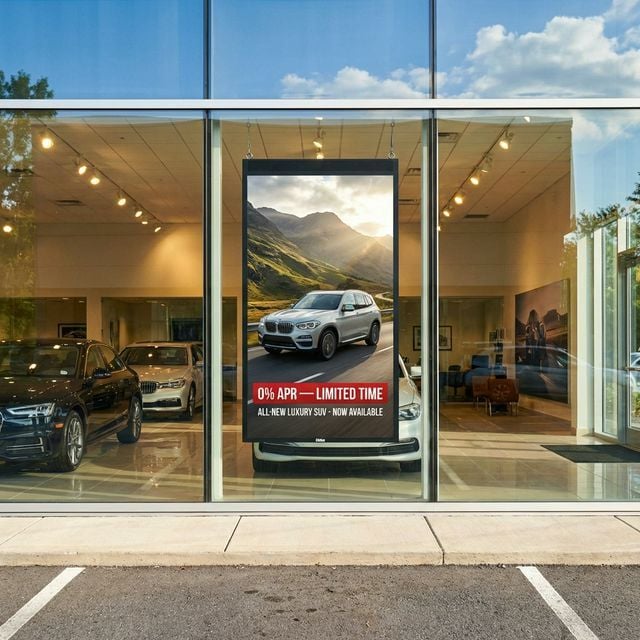
Rendered image
Commercial vs. Consumer Grade: What the Spec Sheet Should Say
Look past the nits number and check four additional data points:
Duty cycle rating. Consumer panels: 8 hours/day. Commercial: 16-hour or 24-hour duty cycle. For storefront 24/7 operation, this determines warranty and lifespan relevance.
Operating temperature range. Window-mounted displays face solar heat gain. Look for at least +131°F (+55°C) upper limit.
Panel lifespan. Consumer TVs: 30,000–40,000 hours at lower brightness levels. Commercial panels: 50,000+ hours of continuous operation = 5.7 years at 24/7 use.
Contrast ratio. High brightness without adequate contrast = flat, washed-out images. Minimum 1,300:1 for high-ambient-light environments.
SeenLabs high-brightness window display screens: 500–3,500 nits, sizes 32"–75", 178-degree viewing angle, 1,300:1 contrast ratio, 50,000-hour lifespan.
24/7 Operation: Heat Management and Panel Longevity
At 50,000 hours running 24/7, a commercial display lasts 5.7 years before reaching 50% of original brightness. At 16 hours/day (typical retail), that extends to 8.6 years.
The 30–40% of customer interactions outside business hours is a real data point. A display that runs through the night captures foot traffic when no staff are present. Only possible with a panel rated and cooled for continuous operation.
Installation Checklist
Before your installer arrives, document:
- Window orientation — compass direction (primary spec input)
- Direct sunlight hours — time range of direct sun on glass
- Window depth and overhang — recessed depth reduces ambient light
- Window tinting — reduces solar gain but also visibility
- Power access — a 2,500-nit 55" panel pulls ~350–400 watts
- Content management setup — wired Ethernet or Wi-Fi
- Thermal environment — summer window alcoves can reach 110–120°F
A 30-minute setup time is realistic for a prepared installation — display mounted, media player connected, content loaded and displaying.
Frequently Asked Questions
How many nits do I need for a window-facing retail display?
North-facing: 700–1,000 nits. South and west-facing with direct sun: 2,000–3,500 nits. Consumer TVs at 250 nits are not viable for any direct-sun window application.
Can I use a regular TV in a store window?
Not effectively. Consumer TVs are rated at 250–400 nits for 8-hour daily use. They throttle brightness under sustained high-output conditions and are not designed for the thermal environment of a sun-exposed window.
What is the lifespan of a commercial window display screen?
50,000+ hours = approximately 5.7 years at 24/7 operation, or 8–10 years at typical retail hours (16 hours/day). Consumer panels reach end-of-life faster at lower brightness.
Does window tinting help reduce the brightness I need?
Reflective tinting reduces ambient light but also reduces panel visibility from outside. Clear anti-reflective coating on the glass is more effective for improving window display performance.
What sizes are available for commercial window displays?
32", 43", 49", 55", 65", and 75". The right size depends on window dimensions, viewing distance from the sidewalk, and content layout.