Why restaurant technology slows service when implemented poorly, and how to fix the paradox.
The promise of digital transformation is simple: technology makes things faster. Automating orders speeds up throughput. Digital menus make decision-making quicker. Kiosks reduce lines.
So why are your lines longer?
Why are customers standing confused in front of screens? Why is the kitchen overwhelmed? Why are apps crashing and driving customers away?
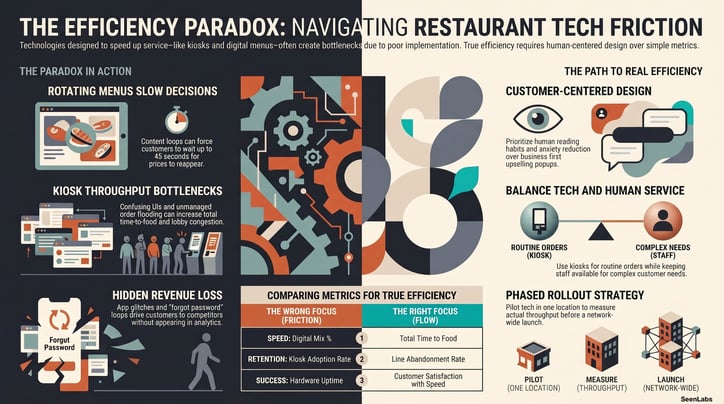
This is the Efficiency Paradox: technologies designed to increase efficiency often achieve the opposite due to poor implementation. The "theoretical" speed of digital is often undermined by the "actual" friction of human interaction with poorly designed systems.
Case studies in paradox
Typical scenarios where tech creates bottlenecks.
Fast menus that slow decisions
A 4K digital menu board rotates through high-res promotional content every few seconds. The idea is that promoting LTOs (Limited Time Offers) will drive sales and engagement. The Paradox:
- Customer looks up to find the burger price.
- Screen wipes to a milkshake ad.
- Customer waits for the burger menu to return.
- Customer misses it again because they checked their phone.
- Result: Ordering takes longer for every customer.
Kiosks that create lines
Self-order kiosks replace 2 cashier lanes. The idea is that customers order simultaneously, doubling throughput. The Paradox:
- Kiosk UI is confusing; customers take longer to order than a cashier takes to enter the same order.
- Orders flood the kitchen faster than they can be cooked (batching issue).
- The "pickup" area becomes a chaotic mosh pit of waiting people.
- Result: Total time-to-food increases; lobby congestion worsens.
Apps that drive drive-offs
A mobile ordering app handles pickup. The idea is to order ahead, grab and go, with zero friction. The Paradox:
- App glitches during login.
- "Forgot Password" loop.
- Customer gets frustrated in parking lot.
- Drives to competitor with a functioning drive-thru.
- Result: Lost sales that never appear in your analytics.
Root causes
Why does this happen?
Business-first logic
A common cause is putting operational metrics ahead of human experience.
- "We need to capture email addresses" → Force login → Friction.
- "We need to upsell sides" → Add 3 popup screens → Delay.
- "We need to cut labor" → Eliminate cashiers before kiosks are adopted → Chaos.
When you design for the business spreadsheet instead of the customer reality, you create paradoxes.
Technology push vs. customer pull
Deploying because it's possible, not because it's needed.
- "Everyone has an app, so we need one."
- "Vendors say rotating menus are cool."
- Tech deployed without a clear problem statement often creates new problems.
Implementation shortcuts
Undervaluing the execution:
- Staff are under-trained. Employees don't know how to help customers use the tech.
- Systems are under-tested. Generic hardware fails in grease and heat.
- Hardware is under-maintained. One broken kiosk out of three creates a bottleneck, not efficiency.
The path to real efficiency
Turning the paradox into productivity.
Customer-centered design
Start with the human:
- How do they actually read a menu? (Left to right, not rotating).
- How much text can they parse? (Less is more).
- What makes them anxious? (Fix that first).
Phased rollout with learning
Don't boil the ocean:
- Pilot in one location.
- Measure actual throughput and dwell time.
- Identify bottlenecks.
- Refine before network-wide launch.
Continuous optimization mindset
Go live is Day 1, not the finish line.
- Monitor where people get stuck.
- A/B test menu layouts for speed.
- Listen to staff feedback (they see the bottlenecks first).
Balance automation and human service
Technology manages the routine; humans manage the exception.
- Kiosks for standard orders.
- Cashiers for complex questions, cash users, or confused guests.
- Don't replace; augment.
Measuring true efficiency
Stop measuring just "Digital Mix."
Bad metric: "80% of orders via kiosk." (Could mean you just closed the counter.) Good metrics: "Total Time to Food" (order start to receipt of food), "Line Abandonment Rate" and "Customer Satisfaction with Speed."
If digital mix is up but satisfaction is down, you have an efficiency paradox.
Technology is a tool, not a solution
A hammer can build a house or break a window. It depends on how you use it.
Digital signage and kiosks can streamline operations. Efficiency comes from good design, and hardware deployment alone does not deliver it.
Stop optimizing for the machine. Start optimizing for the human using it.
About SeenLabs
SeenLabs helps operators navigate the Efficiency Paradox. We build digital signage solutions designed around human throughput.