Stadium drop-off zones are the highest fan-density advertising environment in the host city — per square foot, higher than any fixed billboard
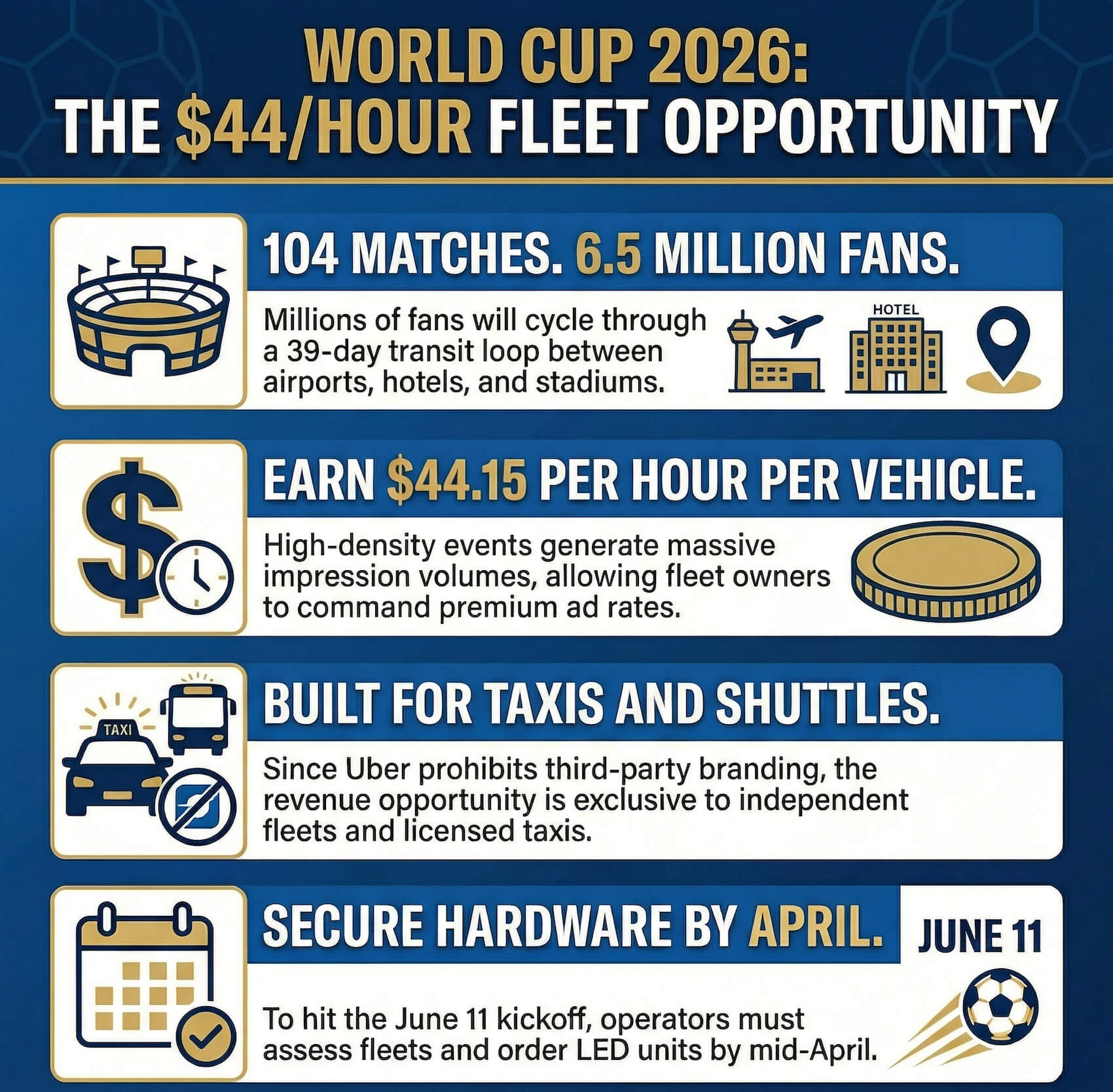
Every World Cup fan makes the same journey. Airport to hotel. Hotel to stadium. Stadium to fan zone. Fan zone to bar. Bar to hotel. Repeat for 39 days across 11 cities.
That transit loop — and the millions of people cycling through it between June 11 and July 19, 2026 — is the single largest mobile advertising opportunity in the history of US out-of-home media. It's not a billboard on a highway that a commuter passes once. It's a moving screen that follows fans through every leg of their trip, every day of the tournament.
And right now, nearly zero content exists to help fleet operators understand how to capture it.
This piece is for taxi companies, shuttle operators, livery services, and independent fleet owners. Not brand advertisers — they have agencies. Not rideshare drivers — most platforms prohibit third-party branding. This is for the operator who owns vehicles and wants to turn them into revenue-generating media assets during the biggest event to ever hit US cities.
The Fan's Journey: Why Mobile Beats Static During a World Cup
Most out-of-home advertising is fixed. A billboard sits on one highway. A bus shelter ad covers one intersection. A window display — as powerful as it is — captures fans walking past one storefront. They all depend on the fan coming to the ad.
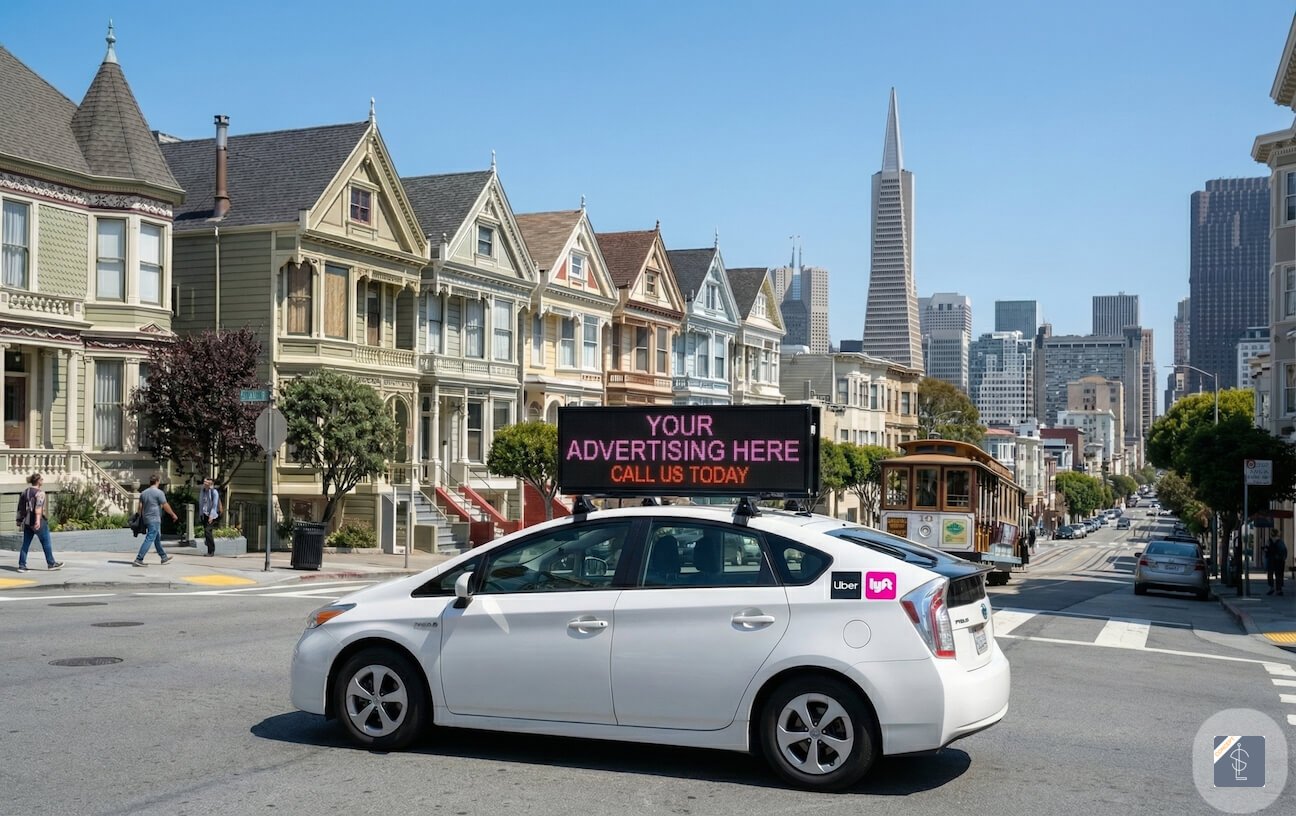
A car rooftop LED inverts this. The ad goes to the fan.
6.5Mstadium attendees expected across 104 matches in 11 US cities
10Minternational visitors projected in the US during the tournament
$95Mprojected transportation spending in US host cities (Travel Daily News)
Consider what a match day looks like in a host city. Dallas hosts 9 matches — the most of any venue. On a typical match day, tens of thousands of fans move from hotels to AT&T Stadium in Arlington. After the match, they disperse to downtown Dallas bars, fan zones, and restaurants. Late at night, they return to hotels. The next morning, tourists explore the city before the cycle repeats.
A fleet of 20 vehicles running rooftop LEDs covers every segment of that journey. The same screen that shows an ad at the airport pickup lane shows it again in the stadium drop-off zone, again cruising through the entertainment district, and again at the hotel corridor at midnight. No other medium follows the fan this way.
The Super Bowl frame: During Super Bowl LIX in New Orleans, the economic activity concentrated in a few square miles for one week. A taxi running a rooftop LED in the French Quarter hit the same 100,000 visitors repeatedly. Now scale that: Dallas alone hosts 9 matches over 5 weeks, each drawing different international fan bases. A rooftop LED fleet in Dallas operates in the equivalent of 9 Super Bowls' worth of captive transit audiences.
The Economics: What a Rooftop LED Earns Per Vehicle
The car-top advertising model is established — even if most fleet operators haven't adopted it yet. Here's how the economics work based on current market data:
Current industry benchmarks
According to The Rideshare Guy and Blindspot data, Uber OOH programs offer $300 install bonus + $100/week for drivers logging 20+ hours — paid to the driver, not the fleet
Lyft acquired Halo Cars (car-top ad startup) in 2020, validating the medium
Traditional taxi-top advertising rates: $150–$400/month per vehicle (Blue Line Media)
World Cup 2026 premium
Event-driven OOH commands 2–5× standard rates during major events
Concentrated advertiser demand: local restaurants, bars, fan zones, and sponsors all competing for visibility
39-day tournament = defined campaign window with clear start/end dates
Multilingual ad capability adds value for international brand campaigns
The key economic insight for fleet operators: during a normal month, a car-top LED generates steady but modest returns. During the World Cup, the same screen is operating in the highest-density advertising environment the US has ever seen. Local businesses need to reach 10 million visitors. Traditional OOH inventory is sold out months in advance. A mobile LED fleet is one of the few media options that can still be deployed — and the demand premium reflects that.
A billboard on I-35 in Dallas reaches commuters. A rooftop LED on a taxi in Dallas during the World Cup reaches tens of thousands of international visitors — at the airport, at the stadium, at the hotel, and at the bar. Every match day.
Which Routes Matter: Stadium Zones, Fan Corridors, and Airport Loops
Not all routes generate equal impressions during a major event. The highest-value zones during the World Cup will be predictable — and fleet operators can optimize for them:
Zone
Why It's High-Value
Timing
Airport pickup / dropoff
Every international visitor arrives and departs here. Captive audience in taxi queues. First and last impression of the city.
All day, peaks around match days ±1 day
Stadium drop-off zone
Highest fan density per square foot in the city. Fans arrive 2–3 hours early, creating extended dwell time.
3–4 hours before kickoff
Hotel corridors
Concentrated fan accommodation areas. Fans mill around before and after matches — high visibility for local business ads.
Morning and late evening
Entertainment / bar districts
Post-match fan dispersal. Fans choose bars and restaurants from the street. A rooftop LED advertising a nearby venue reaches them in the decision moment.
Evening through late night
Fan zone perimeters
Official and unofficial fan zones draw thousands of non-ticket-holding fans. Vehicles circling these areas generate sustained impressions.
Match day, all day
Fleet operators who pre-plan routes around these zones during the tournament operate fundamentally differently from a driver running normal dispatch. The World Cup creates predictable, high-density audience concentrations — and a route strategy built around them maximizes every screen-hour.
The Honest Guide: What Fleet Operators Can and Can't Do
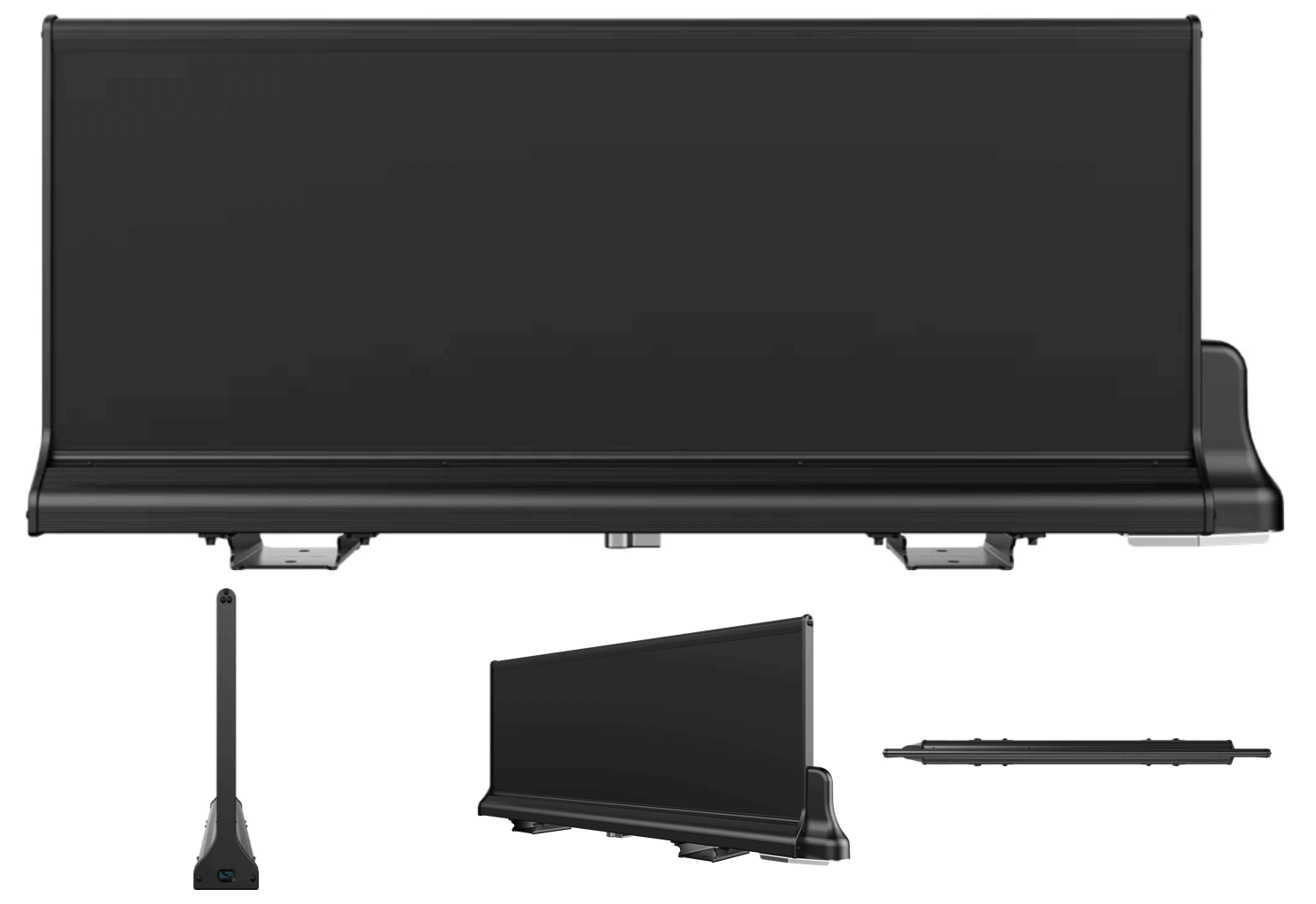
A rooftop LED unit mounted on a vehicle. The screen is visible from multiple angles and designed for outdoor brightness conditions.
This is where most rooftop LED content gets dishonest — and where this article won't. The opportunity is real, but the rules matter:
Uber restriction: Uber explicitly prohibits third-party branding, advertising wraps, and rooftop signage on Uber driver vehicles. If you drive for Uber, you cannot install a rooftop LED and run ads while on the Uber platform. This is a policy, not a suggestion — violations can result in deactivation. Do not install a rooftop screen on a vehicle used for Uber trips.
That said, the opportunity is wide open for operators who own their fleets:
Taxi companies: Licensed taxis have long used rooftop signage. Upgrading from a static backlit panel to an LED screen is a natural evolution. No platform restrictions — you own the vehicle, you control the advertising.
Shuttle and livery services: Airport shuttles, hotel shuttles, and black car services operate predictable high-value routes during major events. A rooftop LED turns dead transit time into revenue-generating impressions.
Independent fleet operators: Small fleets of 5–20 vehicles can sell ad inventory to local businesses directly — no agency required. A restaurant near the stadium pays for ads running on vehicles that pass through the stadium zone on match nights.
Lyft (official program): Lyft acquired Halo Cars in 2020 and has operated its own car-top advertising program. Drivers in the Lyft program can participate through official channels — this is the only major rideshare platform with a sanctioned car-top ad program.
Delivery fleets: Vehicles in service for food delivery or logistics that operate in high-traffic urban areas during the tournament can generate impressions during their normal routes without any operational change.
The Content Strategy: What to Show on a Rooftop LED During the World Cup
A rooftop LED is not a TV. It's a mobile billboard with a 3–5 second view window. The content rules are different:
What works
Local restaurant or bar ads: "Watch Colombia vs Portugal here — 2 blocks ahead"
Fan zone directions and promotions
Hotel welcome messages in multiple languages
Time-sensitive match-day specials
Brand campaigns with strong visual identity (no fine print)
What doesn't
Text-heavy messages — unreadable at traffic speed
QR codes — nobody scans from a moving vehicle
Generic brand awareness with no local relevance
Static content that doesn't change match-to-match
FIFA-trademarked logos or official branding (licensing required)
The strongest rooftop LED campaigns during the World Cup will be hyperlocal: a bar two blocks from the stadium advertising its match-night special, a hotel welcoming guests in Spanish and Portuguese, a fan zone promoting tonight's screening. These ads convert because they reach fans in the right place at the right time — when they're already in transit and looking for exactly that kind of information.
A managed rooftop LED system allows fleet operators to schedule content by time of day, by route, and by match. Morning airport runs show hotel and transportation ads. Evening stadium runs show bar and restaurant promotions. Late-night routes show return transportation options. All from a single dashboard, updated remotely.
The displacement effect: the economic phenomenon where mega-event spending doesn't increase total revenue — it redistributes it from unprepared businesses to visibly prepared competitors. Documented by Clemson University researchers studying economic patterns at major sporting events.
The displacement effect: Clemson University research on mega-events shows that advertising spending during tournaments doesn't distribute evenly — it shifts toward the most visible, best-positioned media. Fleet operators with rooftop LEDs running optimized routes will capture ad budgets that would otherwise go to static billboards or print ads. The operators who don't equip will watch competitors earn the premium rates.
How to Get Started Before June 11
The timeline for a fleet operator is shorter than for a restaurant or bar — but the window is still finite:
Assess your fleet: How many vehicles can carry rooftop units? Standard sedans, SUVs, and vans with roof rails are ideal. Check local regulations for rooftop signage in your city — most host cities permit commercial vehicle-top advertising.
Secure hardware by April: LED rooftop units typically ship in 2–3 weeks and install in under a day. For a June 11 tournament start, orders placed by mid-April give ample setup time.
Build your advertiser pipeline: Approach local restaurants, bars, and hotels near stadiums and fan zones now. Offer match-day ad packages — they're easier to sell with a defined event window and predictable audience numbers.
Plan your route strategy: Map the airport → hotel → stadium → entertainment district loop for your city. Program your highest-value hours around match start times.
Set up content management: A managed platform lets you swap ads between match days, rotate advertisers, and run multilingual content — all from a phone or laptop, remotely.
Can Uber drivers install rooftop LED screens on their vehicles?
No. Uber explicitly prohibits third-party branding, advertising wraps, and rooftop signage on vehicles used for Uber trips. Violations can result in driver deactivation. The car-top LED opportunity is for taxi companies, independent fleet operators, shuttle services, livery companies, and Lyft drivers who participate in Lyft's official car-top program (via the Halo Cars acquisition).
How much can a fleet operator earn from rooftop LED advertising during the World Cup?
Current industry benchmarks show taxi-top advertising rates of $150–$400 per vehicle per month in normal conditions (Blue Line Media). During major events, rates typically command a 2–5× premium due to concentrated advertiser demand and higher impression density. A 10-vehicle fleet running premium match-day rates across the 39-day tournament could generate significantly more than standard monthly rates.
What size are car rooftop LED screens?
Car rooftop LED units come in several form factors. Compact units cover approximately one-third of a standard sedan roof; full-size units span roughly two-thirds. Both are designed for roof rail mounting, weatherproof operation, and visibility in direct sunlight. The screen is visible from multiple angles — sides and rear — maximizing impressions per trip.
Do I need to sell ad space myself, or does the platform handle it?
Both models exist. Some fleet operators sell directly to local businesses — a straightforward approach during a defined event like the World Cup. Others work with ad networks that fill inventory programmatically. With SeenLabs, fleet operators get a managed content platform and can choose to load their own advertiser content or work with the SeenLabs team to fill inventory.
Is a rooftop LED useful after the World Cup ends?
Yes. The World Cup is a catalyst, not the entire value proposition. Car-top LED advertising operates year-round in any high-traffic urban environment. NFL season, holiday shopping, concert tours, conventions — any event that concentrates foot and vehicle traffic creates advertiser demand. The fleet operator who installs for the World Cup retains a revenue-generating asset for years.
Sources & References
The Rideshare Guy / Blindspot — Rideshare Vehicle OOH Advertising Economics
FIFA — 2026 World Cup Official Match Schedule and Venue Data
Clemson University — Economic Displacement Research at Major Sporting Events
SeenLabs Car Rooftop LED — Mobile advertising for fleet and taxi operators
Ready to turn your fleet into a World Cup media platform?
SeenLabs provides car rooftop LED units with a managed content platform for fleet operators. Tell us about your fleet size and city — we'll build a proposal with match-day route optimization.