Understanding how dynamic pricing digital menu boards create customer anxiety—and how operators can use flexible pricing without triggering backlash.
When Wendy's mentioned "dynamic pricing" in an earnings call, the internet exploded.
Headlines screamed about "surge pricing for burgers." Social media filled with outrage. Boycott threats mounted. Wendy's stock dipped. Within days, the company was scrambling to clarify that they never planned real-time demand pricing—just menu flexibility.
The damage was done. And the lesson is clear: digital menus create pricing suspicion that operators must address proactively.
This article explores why customers fear dynamic pricing, what operators actually do with flexible menus, and how to implement pricing strategies that don't destroy trust.
The Uber Effect
To understand customer reaction to digital menu pricing, you have to understand Uber.
How Ride-Share Changed Consumer Expectations
Uber introduced mainstream consumers to visible, real-time demand pricing:
- Fares that multiply during rush hour, rain, or events
- Prices changing while watching the app
- Paying 3x more for the same ride at the "wrong" time
This created a powerful mental model: "Digital = dynamic = unfair."
Transference of Suspicion
Customers now apply the Uber model to any digital interface:
- Airline booking sites: "Prices went up because they tracked my cookies"
- Amazon: "The price changed since yesterday"
- Digital menu boards: "They can raise prices whenever they want"
The mere existence of a digital display creates suspicion that analog menus never faced.
The "Dynamic = Unfair" Mental Model
In customer minds:
- Paper menus = stable, trustworthy prices
- Digital menus = volatile, manipulable prices
Even if you've never changed a price based on demand, customers assume you could—and might.
What Consumers Actually Fear
Understanding specific fears helps address them.
Prices Rising While They Wait
The nightmare scenario: You see a price on the menu board. You wait in line. You reach the counter. The price is now higher.
This almost never happens in practice. But customers believe it could, any moment.
Paying More Than the Person Ahead
Fairness matters deeply:
- "Why should I pay more for the same burger?"
- "Were they charged less because it was 30 seconds earlier?"
- "Am I being punished for being behind in line?"
Even theoretical inequality creates resentment.
Being Penalized for Peak-Time Visits
Customers who visit during lunch rush:
- Already accept longer wait times
- Already accept more crowded conditions
- Don't want to also pay higher prices
"Surge pricing" feels like exploitation of necessity.
Lack of Price Predictability
Customers value knowing what to expect:
- "My Big Mac costs $X"
- "I budget $Y for my weekly lunch visits"
- "I can plan around price"
Dynamic pricing threatens this predictability.
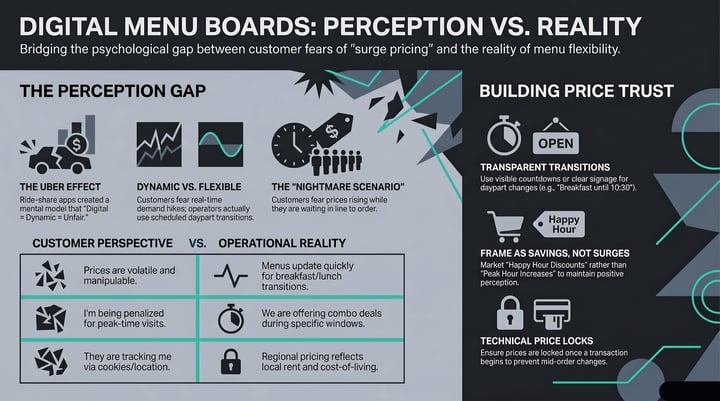
What Operators Actually Do
The gap between customer perception and operational reality is vast.
Daypart Pricing
The most common digital menu "flexibility":
- Breakfast prices differ from lunch prices
- This has existed since breakfast menus existed
- Digital just makes the transition faster
Customer perception: "They're doing Uber pricing!" Reality: "We switch from eggs to burgers at 10:30 AM."
Promotional Rotations
Another legitimate use:
- Happy hour pricing during afternoon slump
- Limited-time offer activation
- Bundle deals at specific times
Customer perception: "Prices are volatile!" Reality: "We put the combo deal up at 3 PM every day."
Localized Pricing Variations
Different locations may have different prices:
- High-rent downtown locations vs. suburban
- Regional cost-of-living adjustments
- Airport or tourist area pricing
Customer perception: "They're charging me more because of my location right now!" Reality: "Manhattan rent is 5x what Iowa rent is."
The Critical Distinction
Dynamic (what customers fear): Prices change in real-time based on current demand.
Flexible (what operators do): Prices change on schedule based on daypart, location, or promotion calendar.
Almost no QSR operates true real-time demand pricing. But customers assume they all do.
The Communication Gap
Why does this perception gap exist?
Operators' Intent vs. Consumer Perception
When operators talk about digital menu "flexibility," they mean:
- Updating prices without printing new menus
- Changing promotions quickly
- Managing daypart transitions smoothly
When consumers hear "flexibility," they think:
- Prices can change any time
- Probably based on how busy it is
- I'm going to get gouged
Why "Menu Flexibility" Sounds Like "Price Gouging"
Language matters. Industry terms carry baggage:
- "Dynamic" → surge pricing
- "Flexibility" → volatility
- "Real-time updates" → instant price hikes
- "AI-driven" → algorithmic exploitation
Every capability description can be heard as a threat.
How Silence Makes It Worse
When operators say nothing about pricing:
- Customers assume the worst
- Speculation fills the void
- Social media shapes the narrative
- One viral post defines the brand
Proactive communication is essential.
Best Practices for Price Trust
Operators can use digital menu flexibility while maintaining customer trust.
Transparency
Clear daypart transition announcements:
- "Breakfast prices until 10:30 AM"
- Visible countdown to menu change
- Staff awareness of transition timing
Visible pricing validity:
- "These prices valid for [current daypart]"
- No hidden asterisks or time limitations
- What you see is what you pay
Consistent pricing within meal periods:
- No changes during a daypart
- Customer in line at 12:15 gets same price as customer at 12:45
- Stability during operating windows
Communication
Explain value, not just prices:
- Focus on what customers get
- Frame promotions as savings opportunity
- Emphasize quality and convenience
Framing deals as savings, not surge:
- "Happy hour special: $2 off from 2-5pm" → GOOD
- "Peak pricing: $2 more from 11-2pm" → BAD
Same price difference, completely different perception.
Staff training on price questions:
- Prepare for "do prices change?" questions
- Script that emphasizes consistency
- Empowerment to address concerns
Technical Safeguards
Preventing mid-transaction price changes:
- Price locks when order is started
- No changes while customer is ordering
- Grace period at transaction boundaries
Audit logging for compliance:
- Complete record of every price displayed
- Ability to prove what customer saw
- Protection against disputes
Customer-visible price guarantees:
- "Price you see is price you pay"
- Display that builds confidence
- Competitive differentiation
How SeenLabs Helps
SeenLabs CMS directly manages pricing display and daypart transitions:
Price Consistency Display Consistent pricing shown across all screens simultaneously, eliminating discrepancy confusion.
Audit Logging Complete tracking of all content and pricing changes for compliance and dispute resolution.
Communication Templates On-screen messaging templates about pricing policies, helping build trust through transparency.
Conclusion: Digital Doesn't Have to Mean Suspicious
The flexibility of digital menus is a genuine advantage. But that advantage requires trust.
Key Takeaways
1. Customers fear Uber-style pricing — Address this fear proactively
2. Most QSR flexibility is scheduling, not surge — Communicate the difference
3. Transparency builds trust — Show customers what to expect
4. Consistency within dayparts matters — Stability during operating windows
5. Language shapes perception — Choose words carefully
6. Silence is filled with speculation — Be proactive about communication
The restaurant that uses digital menu flexibility while maintaining trust earns both operational advantage and customer confidence. The restaurant that triggers pricing suspicion loses both.
Ready to Implement Transparent Pricing?
About SeenLabs
SeenLabs builds digital signage with transparency engineered in. Our platform helps operators benefit from digital flexibility while maintaining the customer trust that drives loyalty.