Lessons from the Wendy's dynamic pricing controversy that every QSR operator should understand before communicating about digital menu capabilities.
TopicCommunication risk
IndustryQSR / Digital Menu Boards
In February 2024, Wendy's CEO mentioned on an earnings call that the company was investing in digital menu boards that could enable “dynamic pricing.”
What followed was a masterclass in how NOT to communicate about technology capabilities.
Within hours, headlines announced “Wendy’s to introduce surge pricing.” Social media erupted with boycott threats. Competitors weaponized the story. A week later, Wendy’s was desperately clarifying that they never intended real-time demand pricing—just basic daypart menu capabilities that every QSR already uses.
The damage lingered far longer than the clarification.
1) What happened
How a single phrase turned into a national narrative.
2) Why it failed
Loaded wording + missing context + no customer framing.
3) What operators should do
A repeatable playbook for trust-safe messaging.
Timeline of the Crisis
Understanding the sequence reveals how quickly communication failures cascade.
STEP 1
The Initial Statement
When
February 2024 earnings call.
Actual context
Testing menu board updates, daypart transitions, and promotional flexibility. Standard digital signage capabilities.
Perceived meaning
Uber-style surge pricing for hamburgers.
STEP 2
Media Amplification
Within 24 hours
The narrative locked in. Facts became secondary.
- Headlines: “Wendy’s plans to charge more when you’re hungry”
- News segments explaining “how it works”
- Competitor response: Burger King tweets about “stable pricing”
STEP 3
Social Media Explosion
Reaction
Disproportionate to the plan — proportionate to the fear triggered.
- #BoycottWendys trending
- Viral posts with millions of impressions
- Screenshots of the stock price drop
- Memories of previous corporate overreach
- “We have no plans to increase prices when demand is high”
- “Dynamic pricing referred to offers and promotions”
- “We apologize for any confusion”
Clarifications never travel as far as controversies. Many customers never saw the correction.
STEP 5
Long-Term Reputation Impact
- “Wendy’s surge pricing” remained in public memory
- Brand sentiment surveys showed lasting damage
- Competitors continued referencing it
- Every mention of digital menus triggered association
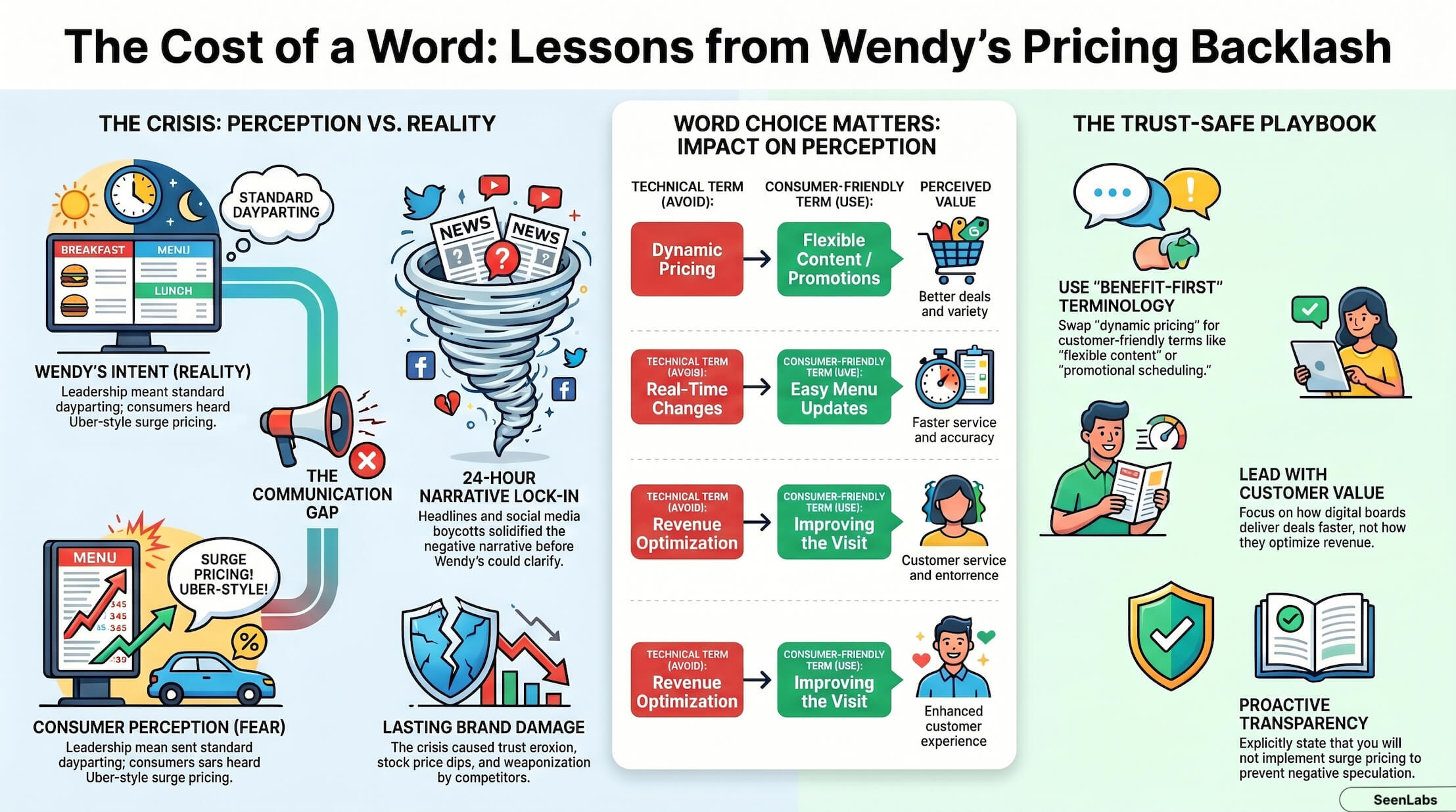
What Wendy's Actually Meant
The gap between intention and perception was enormous.
Daypart Pricing Flexibility
What they planned
- Digital boards switch from breakfast to lunch automatically
- This is what digital signage always does
What was heard
- Prices will change based on how busy we are
What they planned
- Deploy limited-time offers at specific times
- Activate happy hour pricing during slow periods
What was heard
- Higher prices during lunch rush
What they planned
- Update menus without printing costs
- Test different layouts and designs
What was heard
- Real-time algorithmic pricing
NOT real-time demand pricing
Raise prices during peak hours
Charge different prices to different customers
Implement Uber-style surge pricing
But by the time these clarifications emerged, the narrative was set.
Why the Message Failed
Several communication failures combined to create the crisis.
1) Poor Word Choice
“Dynamic” mapped directly to surge pricing in consumers’ minds.
Why it backfired
- Associated with ride-share surge pricing
- Implies real-time changes
- Feels algorithmic/manipulative
Safer alternatives
- Flexible content displays
- Easier menu updates
- Improved promotional capabilities
Words carry baggage. “Dynamic pricing” carries a suitcase.
2) Lack of Context
Investor language without consumer framing.
Investors hear
Revenue optimization opportunity
Consumers hear
They’re going to gouge me
Same words, opposite reactions. Consumer context was never provided.
3) No Customer Benefit Framing
Capability-first messaging triggers suspicion.
What they led with
- What operators can do (flexibility)
- Not what customers get (experience)
Better framing
“Digital boards let us launch promotional deals faster.”
4) Riding the Uber Association
Consumers were primed to fear demand-based pricing.
Uber had already primed consumers to fear demand-based pricing. Wendy’s walked directly into that minefield by using the same terminology. The association was immediate, automatic, and devastating.
The Lasting Damage
The crisis had measurable consequences.
Customer Trust Erosion
- Increased skepticism about pricing
- Concern that prices were manipulated
- Reduced trust vs. competitors
Trust damage takes years to unwind.
Competitive Weaponization
- Burger King tweets about “stable” pricing
- Industry social teams piled on
- Narrative became an industry meme
Free negative advertising at scale.
Internal Disruption
- Leadership attention diverted to crisis response
- Technology work paused
- Marketing shifted to damage control
- Staff fielded customer concerns
Operational distraction compounds reputational damage.
Stock Price Impact
Short-term decline following the controversy. While markets can recover, the link between communication errors and shareholder value was clear.
Lessons for Other Operators
Every operator considering digital menu communication should learn from this incident.
Operator playbook
Messaging + implementation + preparedness, structured for reuse.
Communication Strategy
Lead with customer benefit
- “Our new digital boards let us show you deals faster.”
- NOT “Our new boards give us pricing flexibility.”
Avoid loaded terminology
- “Flexible content” instead of “dynamic pricing”
- “Easy updates” instead of “real-time changes”
- “Promotional scheduling” instead of “demand-based offers”
Proactive transparency
- Explain before speculation fills the void
- Address fears directly: “We will never surge price like ride-share”
- Publish clear pricing policies
Technology Implementation
Features should be invisible when trust-sensitive
- Show benefit, not mechanism
- “Better deals” not “better targeting”
Focus on value, not capability
- What improves the visit?
- What changes the customer notices?
- How do they benefit?
Staff training
- Prepare for “do prices change?” questions
- Clear, honest scripts
- Empower staff to reassure
Crisis Preparedness
Have a response plan
- Who responds?
- What channels?
- How quickly?
- What message?
Know your talking points
- Clear explanation of what you do
- Specific commitment on what you won’t do
- Evidence of consistent pricing
Social monitoring
- Catch issues early
- Respond before narratives harden
- Engage directly with concerns
How SeenLabs Contributes
This article provides industry analysis on communication strategy. SeenLabs helps through:
Case Study Analysis
Documenting lessons from industry pricing missteps so operators can avoid similar errors.
Communication Best Practices
Guidance on framing digital menu capabilities in ways that build rather than undermine trust.
Implementation Guidance
How to roll out pricing features without triggering backlash.
Staff Training Resources
Preparing teams to answer customer questions confidently and consistently.
Conclusion: The Capability Isn't the Problem
Wendy's didn't have a technology problem. They had a communication problem.
Digital menu flexibility is genuinely valuable. Daypart transitions, promotional scheduling, and easy updates are legitimate advantages. The mistake was describing them in words that triggered consumer fear.
1) Avoid “dynamic pricing”
Loaded terminology that triggers surge pricing assumptions.
2) Lead with customer benefit
Explain what improves the visit, not what optimizes revenue.
3) Assume worst-case interpretation
That’s what social media will amplify.
4) Be proactively transparent
State clearly what you will not do.
5) Train staff
They’re the frontline for “do prices change?” questions.
6) Have a crisis plan
Messaging speed matters as much as correctness.
The operator who learns from Wendy's mistake can implement the same technology capabilities without triggering the same reaction. The difference is entirely in the communication.
Ready to Communicate Your Digital Capabilities Effectively?