Understanding self order kiosk hygiene concerns that create adoption barriers—and strategies to address them.
When did you last see someone wipe down a kiosk screen?
How about the 200 people who used it before you?
Post-pandemic, public touchscreens occupy a unique space in customer consciousness. They're perceived as high-contact surfaces that strangers constantly touch—and that rarely appear to be cleaned. Whether or not this perception matches reality, it creates a formidable psychological barrier to kiosk adoption.
This article explores the hygiene perception gap and strategies for addressing it.
---
---
The "Petri Dish" Perception
Customer language about kiosk hygiene is visceral and widespread.
How Customers Describe Kiosks
In reviews, social media, and forums, customers use intense language:
- "Coated in fingerprints and grease"
- "Covered in other people's dirty hands"
- "Haven't seen anyone clean it in an hour of watching"
- "I'd rather wait in line for the counter"
The emotional intensity exceeds what they'd express about most restaurant elements.
Social Media Amplification
Negative hygiene experiences spread:
- Photos of visibly dirty screens
- Videos of people using kiosks with visible food on fingers
- Comments amplifying concerns
- Confirmation bias: "I knew it!"
One viral post shapes thousands of perceptions.
The Perception vs. Reality Gap
Are kiosks actually dangerous?
Reality:
- Touchscreens aren't dramatically more contaminated than other surfaces
- Regular cleaning maintains reasonable hygiene
- Hand sanitizer use after touching eliminates most concern
Perception:
- Every stranger's germs are on that screen
- No one ever cleans it
- I could get sick from using it
Perception is what drives behavior. Reality is less relevant.
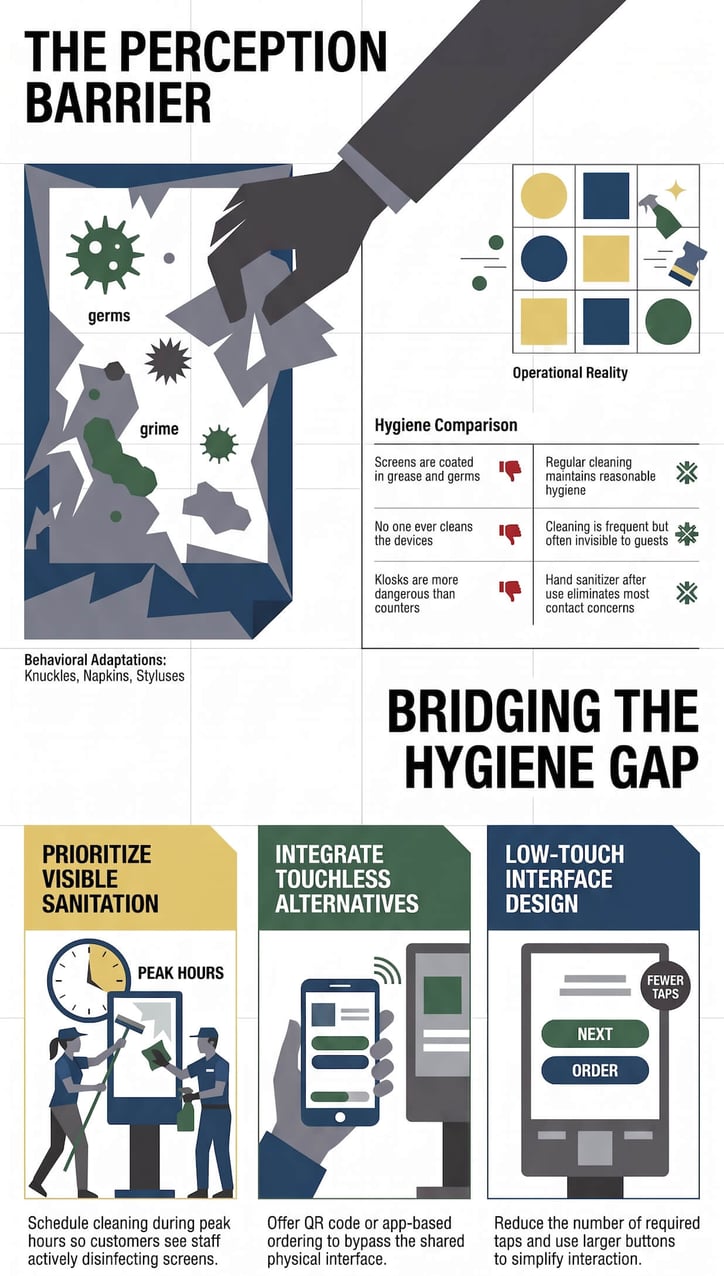
Behavioral Adaptations
Customers develop strategies to cope with hygiene concerns.
Knuckle Tapping
Some customers tap screens with knuckles instead of fingertips:
- Keeps fingerpad skin away from surface
- Still allows interaction
- Visible behavior signal of concern
Napkin Barriers
Others create physical barriers:
- Hold napkin between finger and screen
- Use sleeve edge to tap
- Paper towel as interface shield
Stylus Users
A subset brings tools:
- Personal styluses carried for this purpose
- Pen caps used as pointers
- Anything to avoid direct skin contact
Complete Avoidance
Many simply refuse:
- "I don't use those things"
- Counter-only customers regardless of wait
- May leave if counter is unstaffed
Post-Use Hygiene
Those who do use kiosks often:
- Immediately seek hand sanitizer
- Wash hands in restroom before eating
- Feel contaminated until cleaned
These behaviors indicate underlying anxiety—not comfort.
---
The Business Impact
Hygiene concerns affect business metrics.
Kiosk Underutilization
If significant customer segments avoid kiosks:
- Investment isn't delivering expected returns
- Labor savings don't materialize
- Throughput improvements don't appear
- ROI calculations miss projections
Counter Staff Overwhelmed
When kiosk-avoiding customers crowd the counter:
- Wait times increase for everyone
- Staff stress compounds
- Service quality suffers
- The "kiosk solves labor shortage" theory fails
Customer Abandonment
Some customers leave rather than use kiosks:
- If counter is unstaffed or line is long
- They choose competitors
- Lost transaction + lost future visits
Brand Perception Damage
"They don't care about hygiene" becomes brand association:
- Affects overall dining perception
- Extends beyond kiosk to food safety
- Hard to reverse once established
---
Hygiene Solutions
Multiple approaches address the concern.
Visible Sanitation
Staff cleaning schedules (visible to customers):
- Schedule cleaning during peak visibility hours
- Staff wearing gloves, wiping screens
- Customers SEE the cleaning happening
Antimicrobial screen coatings:
- Surfaces that inhibit bacterial growth
- May be marketing as much as chemistry
- Creates perception of active protection
Self-cleaning technologies:
- UV-C light sanitizing between users
- Automated wipe mechanisms
- Visible cleaning action
Sanitation stations adjacent to kiosks:
- Hand sanitizer dispensers immediately available
- Wipes for customers who want them
- Clean-before-and-after encouraged
Touchless Alternatives
For customers who simply won't touch:
QR code ordering from personal device:
- Scan code, order on own phone
- No shared surface contact
- Familiar, trusted device
Voice-activated ordering:
- Speak order, no touch required
- Technology improving rapidly
- Noise and accuracy challenges remain
App-based ordering with pickup:
- Order before arriving
- Walk in, pick up, never touch kiosk
- Best experience for hygiene-sensitive
NFC tap-to-start:
- Phone tap initiates session
- Order on kiosk or phone
- Reduces but doesn't eliminate touch
Low-Touch Design
Reduce required screen contact:
Fewer required taps:
- Streamline ordering flow
- Combine screens where possible
- Less contact = less concern
Larger buttons:
- Easier targeting
- Less precise aiming needed
- Reduces repeated taps
Confirmation without touch:
- Card tap to confirm instead of button
- NFC confirmation
- Minimal final contact
---
Communication Strategies
What you say affects perception.
On-Screen Hygiene Messaging
Display visible cleanliness information:
- "Sanitized every 30 minutes"
- "Antimicrobial screen coating"
- "Hand sanitizer available below"
Make claims visible and credible.
Staff Verbal Communication
Train staff to address concerns:
- "We clean these screens frequently"
- "There's hand sanitizer right here"
- "I can take your order at the counter if you prefer"
Acknowledge concern without defensiveness.
Visible Cleaning Supplies
Physical presence of supplies builds confidence:
- Sanitizer dispensers at each kiosk station
- Wipe containers visible
- Cleaning spray and cloths in view
The supplies themselves communicate care.
Customer Feedback Mechanisms
Invite hygiene feedback:
- "Notice a dirty screen? Let us know"
- QR code for hygiene feedback
- Staff response visible when reported
Responsiveness builds trust.
---
How SeenLabs Helps
Physical hygiene is an operational issue. SeenLabs CMS contributes through digital alternatives and communication:
QR Code Integration Display QR codes for personal device ordering directly on menu boards, giving hygiene-sensitive customers an alternative.
Hygiene Messaging On-screen content templates about cleaning schedules and practices, making hygiene efforts visible.
Multi-Channel Promotion Encourage app/mobile ordering as touchless alternative through menu board messaging.
Content Templates Pre-built messaging like "Sanitized every 30 minutes" ready for deployment.
---
Conclusion: Perception Matters as Much as Reality
Customers who perceive kiosks as dirty won't use them—regardless of actual contamination levels.
Key Takeaways
1. Post-pandemic sensitivity is real — Hygiene concerns aren't going away 2. Perception drives behavior — Actual contamination level is less relevant 3. Visible cleaning builds trust — What customers see matters 4. Alternatives address the segment that won't touch — QR, app, voice 5. Communication is critical — Say what you do 6. Supplies as signals — Visible sanitizer shows you care
The restaurant that addresses hygiene perception earns kiosk adoption. The restaurant that ignores it loses customers to alternatives—including competitors.
---
Ready to Explore Touchless Ordering Alternatives?
---
About SeenLabs
SeenLabs builds digital signage that supports multiple ordering channels. Our platform helps operators communicate hygiene practice and offer touchless alternatives for customers who prefer them.