The Rise of Hyper-Customization
Social media has transformed how customers approach ordering.
The "Secret Menu" Phenomenon
What started as insider knowledge has become mainstream:
- TikTok videos with millions of views showing custom drink builds
- "Secret menu" items that aren't on any official menu
- Influencers creating signature drinks with extensive modifications
- Comments sections sharing exact order specifications
Customers screenshot these orders and read them verbatim to staff—or enter them into digital ordering systems.
Why Digital Interfaces Enable Extremes
In a counter interaction, human judgment naturally limits customization:
- Baristas might ask clarifying questions
- Obviously contradictory requests get caught
- Social friction discourages extreme orders
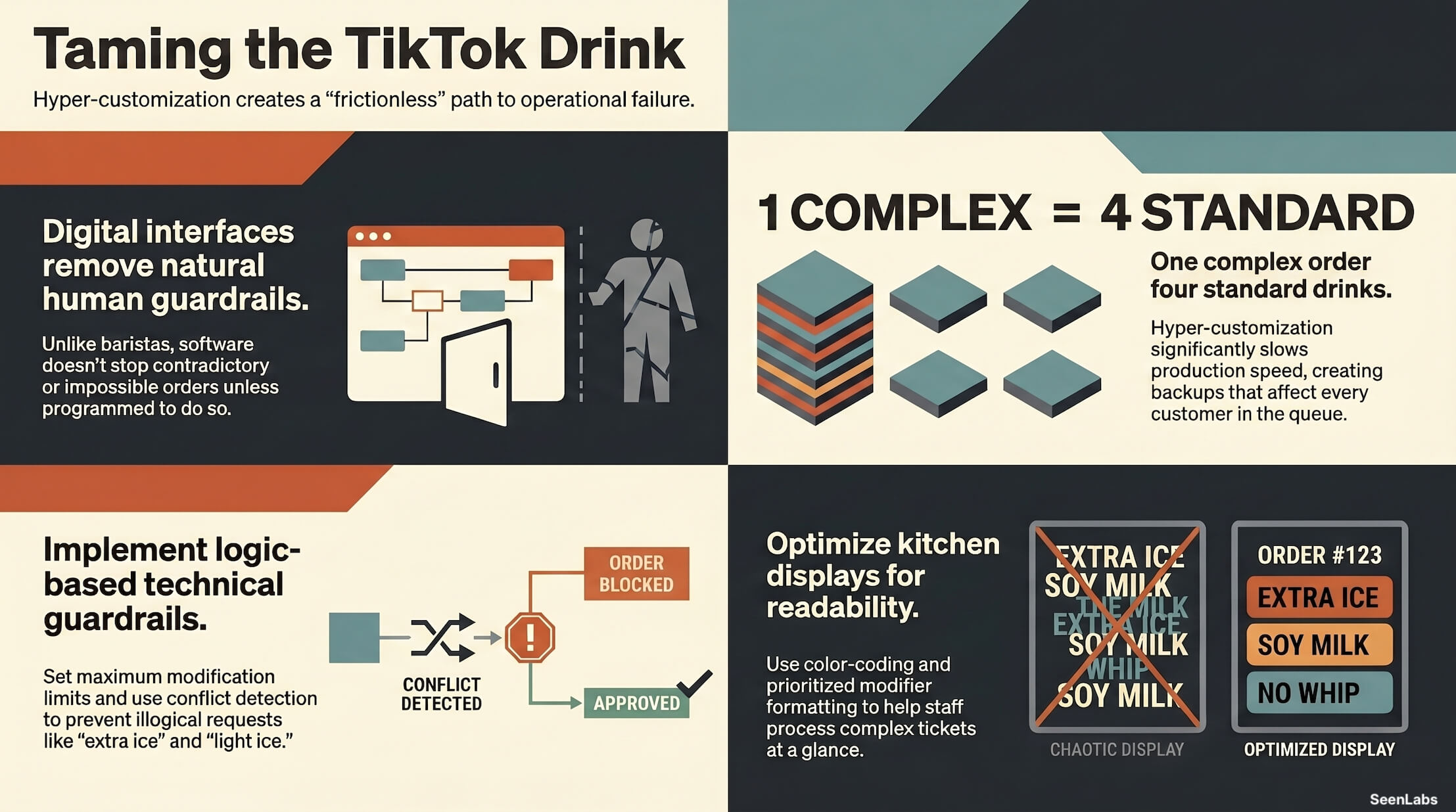
Digital interfaces remove these guardrails:
- No judgment—every modification is just a button
- No friction—adding modifications is easy
- No conflict detection—contradictory requests are accepted
- No limits—until you hit a submission button
The system says "yes" to everything; the kitchen says "what?"
---
Operational Impacts
Hyper-customized orders create cascading problems.
Ticket Readability
When a ticket contains 15+ modifications:
- Critical details are buried in noise
- Staff must read the entire ticket carefully
- Abbreviations become confusing (what's "XC NW 12V OML UPSD"?)
- Important instructions get missed
A standard drink takes a glance to build. A TikTok drink requires careful study.
Production Speed
Customization takes time:
- Each modification requires action
- Complex combinations require more thought
- Unusual requests may require clarification
- Mistake correction adds rework time
One hyper-customized drink can take as long as 3-4 standard drinks. During rush periods, this creates queue backup that affects every customer.
Error Rates
Complexity breeds errors:
- Modifications missed in the noise
- Contradictory instructions followed incorrectly
- Staff interpretation varies
- Customer expectations rarely match execution
Each error triggers:
- Customer complaint
- Remake time
- Wasted ingredients
- Staff demoralization
Staff Stress and Turnover
Staff who regularly handle impossible orders experience:
- Frustration at ambiguous instructions
- Anxiety about customer reactions
- Physical exhaustion from complex builds
- Resentment toward the system that allows it
Staff turnover has real costs. Hyper-customization contributes to burnout.
Technical Solutions
Technology can help manage customization complexity.
Guardrails in the Interface
Maximum modification limits:
- Cap total modifications per item (e.g., 8 maximum)
- Display warning before limit: "Your order is getting complex—are you sure?"
Conflict detection:
- Prevent logically contradictory requests
- "Extra ice" and "Light ice" can't both be selected
- "No whip" automatically deselects whip-dependent modifications
Warning thresholds:
- After X modifications, display message: "Complex orders may take longer and vary in execution"
- Set expectations before submission
Complexity surcharges:
- Beyond a threshold, each additional modification adds cost
- Creates natural limit through price signal
- Compensates for production time
Kitchen Display Optimization
When complex orders do come through, display them effectively:
Prioritized modifier display:
- Base item and size most prominent
- Dairy/milk alternatives highlighted
- Additions grouped logically
- Special instructions separated
Color coding:
- Green: additions
- Red: removals
- Yellow: substitutions
- Standard items: default color
Condensed formatting:
- Abbreviations that staff are trained on
- Logical grouping reduces visual scanning
- Most important info first
Spoken readback:
- For extremely complex orders, audio readback
- Staff can listen while building
- Reduces re-reading time
---
Policy Considerations
Technology alone isn't enough—policy guides human judgment.
Communicating Limits to Customers
Be transparent about what's possible:
- "Complex customizations may vary in execution"
- "Orders exceeding X modifications may experience delays"
- Display estimated wait time for complex orders
Set expectations before disappointment.
Handling Social Media Reference Orders
When customers say "I want the TikTok drink":
- Train staff on common viral drinks
- Create internal documentation of popular builds
- Have a script for clarifying vague references
- Offer to show the customer what you understood before making
Training Staff on Complex Builds
Staff need skills for unusual situations:
- Reading complex tickets systematically
- Asking clarifying questions without offense
- Managing customer expectations for unique builds
- Handling remakes professionally
When to Say No
Some requests should be declined:
- Physically impossible combinations
- Food safety concerns
- Requests exceeding system capabilities
- Orders that would halt production for others
Train staff on how to decline respectfully and what alternatives to offer.
---
Balancing Customization and Operations
Customization is genuinely valuable. Customers appreciate personalization. The goal isn't to eliminate it—it's to manage it sustainably.
The Sustainable Middle Ground
Enable reasonable customization:
- Common modifications easy to access
- Popular combinations available as presets
- Allergen and dietary modifications always available
Discourage extreme customization:
- Friction increases with complexity
- Price increases with complexity
- Wait time estimates increase with complexity
- Warning messages set expectations
Optimize for the middle:
- The customer who wants oat milk instead of whole milk is common
- The customer who wants 15 modifications is rare
- Design for common cases; tolerate rare cases
Measuring the Impact
Track the data:
- Production time by modification count
- Error rates by order complexity
- Customer complaints by customization level
- Staff satisfaction surveys
Use data to calibrate your approach.
---
How SeenLabs Contributes
Order customization logic resides in POS and ordering software. SeenLabs contributes through:
Operational Best Practices Documenting strategies for managing complex orders across the industry.
Kitchen Display Integration CMS can display order data from KDS in optimized, readable formats when integrated.
Vendor Guidance Evaluating ordering systems for appropriate customization guardrails.
Industry Analysis Benchmarking how major brands handle the hyper-customization challenge.
---
Conclusion: Technology Should Enable, Not Create Chaos
Digital ordering should make operations smoother, not more chaotic. When interfaces allow orders that kitchens can't execute, the technology has failed.
Key Takeaways
1. Social media has changed ordering expectations — Customers expect limitless customization 2. Digital interfaces remove natural guardrails — No human judgment filters extremes 3. Complexity has real operational costs — Time, errors, staff stress 4. Technical guardrails help — Limits, conflict detection, complexity pricing 5. Display optimization matters — Make complex orders readable 6. Policy completes the picture — Training, communication, limits
The restaurant that manages customization well gets the benefits of personalization without the chaos of extremes.
---
Implementation Checklist
- [ ] Review your maximum modification settings
- [ ] Implement conflict detection for contradictory requests
- [ ] Optimize KDS display for complex orders
- [ ] Train staff on handling extreme customization
- [ ] Create internal docs for common viral orders
- [ ] Track production time by modification count
---
Ready to Manage Order Complexity Better?