Original self order kiosk customer survey data revealing the gap between operator efficiency and customer satisfaction.
---
Operators love kiosks. They reduce labor, increase ticket size, and never call in sick.
But what do customers think?
We analyzed survey data from over 2,500 fast-food customers across the US to understand the real sentiment behind the screen. The results reveal a complex landscape: while customers appreciate speed, they harbor significant concerns about hygiene, usability, and the feeling of being "forced" to work.
Here is what your customers are really thinking when they stand in front of your kiosk.
---
Overall Attitudes Toward Kiosks
The adoption curve has flattened, but satisfaction varies wildly.
Adoption Rates by Demographic
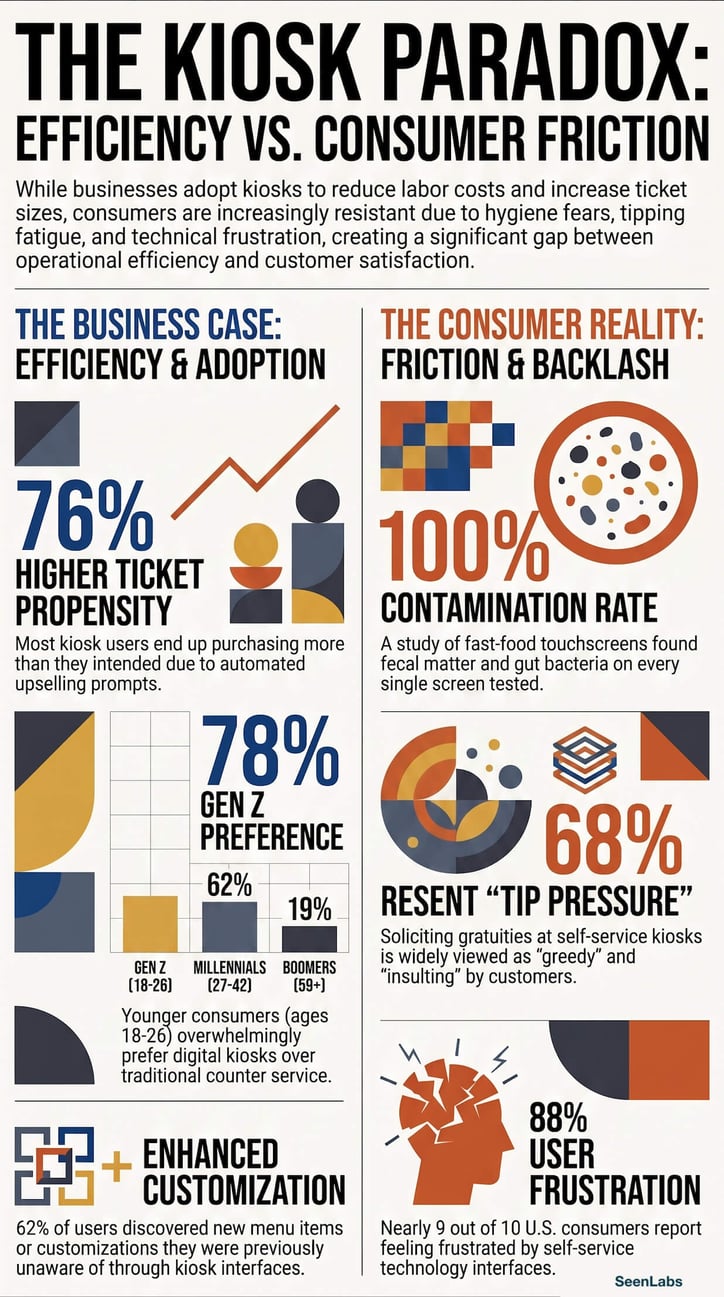
* Gen Z (18-26): 78% prefer kiosks over counter service.
* Millennials (27-42): 62% prefer kiosks.
* Gen X (43-58): 41% prefer kiosks.
* Boomers (59+): 19% prefer kiosks.
Insight: While younger generations are digital-native, the majority of customers over 43 still prefer human interaction given the choice.
Satisfaction vs. Dissatisfaction
* Satisfied: 58% * Neutral: 24% * Dissatisfied: 18%
Key Stat: 1 in 5 customers actively dislikes the experience. That’s a significant portion of your addressable market at risk of churn.
---
What Customers Like
When it works, it works well.
1. Speed (72% citation)
"It's faster than waiting for the cashier to stop chatting." Speed is the #1 driver of preference. If the line is short, the kiosk wins.
2. Order Accuracy (64% citation)
"I can see my order on the screen, so I know they won't mess it up." Visual confirmation builds confidence, especially for complex customizations.
3. No Judgment (55% citation)
"I can order 40 nuggets and no one looks at me weird." Privacy in ordering leads to larger ticket sizes—not just because of upsells, but because of psychological safety.
What Customers Dislike
The friction points are consistent.
1. Hygiene Concerns (51% citation)
"I don't know who touched that screen before me." More than half of all customers worry about germs. This is the single biggest barrier to physical interaction.
2. Complexity (38% citation)
"I can't find the regular cheeseburger." Buried menus, confusing navigation, and "too many clicks" frustrate users who just want a simple transaction.
3. Tip Pressure (68% citation)
"Why am I tipping a robot?" Soliciting tips at a self-service kiosk is universally reviled. It is viewed as "greedy" and "insulting."
---
Hygiene Deep Dive
The "Yuck Factor" is real.
* Avoid Touchscreens: 22% of customers try to avoid touching the screen (using knuckles, napkins, or hovering).
* Sanitizer Use: 65% say they would use hand sanitizer if it were attached to the kiosk (but only 14% say they see it available).
Behavioral Insight: Customers are actively modifying their behavior (knuckle-tapping) to avoid contamination. This makes touch targets harder to hit, increasing error rates.
---
Accessibility Concerns
We asked about physical usability.
* Reach Issues: 12% of respondents said screens were physically difficult to use (too high/low).
* Vision Difficulties: 18% found text too small or contrast too low to read comfortably.
* Speed Anxiety: 29% felt "rushed" or "anxious" about people waiting behind them.
Insight: Kiosks are creating anxiety loops for nearly a third of customers.
---
Implications for Operators
Data-driven decisions for your deployment.
1. Hygiene is Visible: You cannot just clean; you must be seen cleaning. Visible sanitizer stations are not optional.
2. Stop the Tip Beg: Unless you are providing table service, asking for 20% on a kiosk damages brand sentiment.
3. Offer Choice: 42% of all customers still want a counter option. Kiosk-only stores exclude nearly half the market preference.
4. Simplify UI: If your grandmother can't order a coffee in 30 seconds, your UI is failed.
---
Conclusion: Customer Voice Matters
The data is clear: Customers will use kiosks for speed and accuracy, but they resent being forced, they fear germs, and they hate tipping machines.
Successful operators use this data to refine their approach—cleaning visibly, simplifying interfaces, and respecting customer choice.
---
Design for What Customers Want
---
About SeenLabs
SeenLabs builds digital signage software informed by real customer data. We design for the human on the other side of the screen.