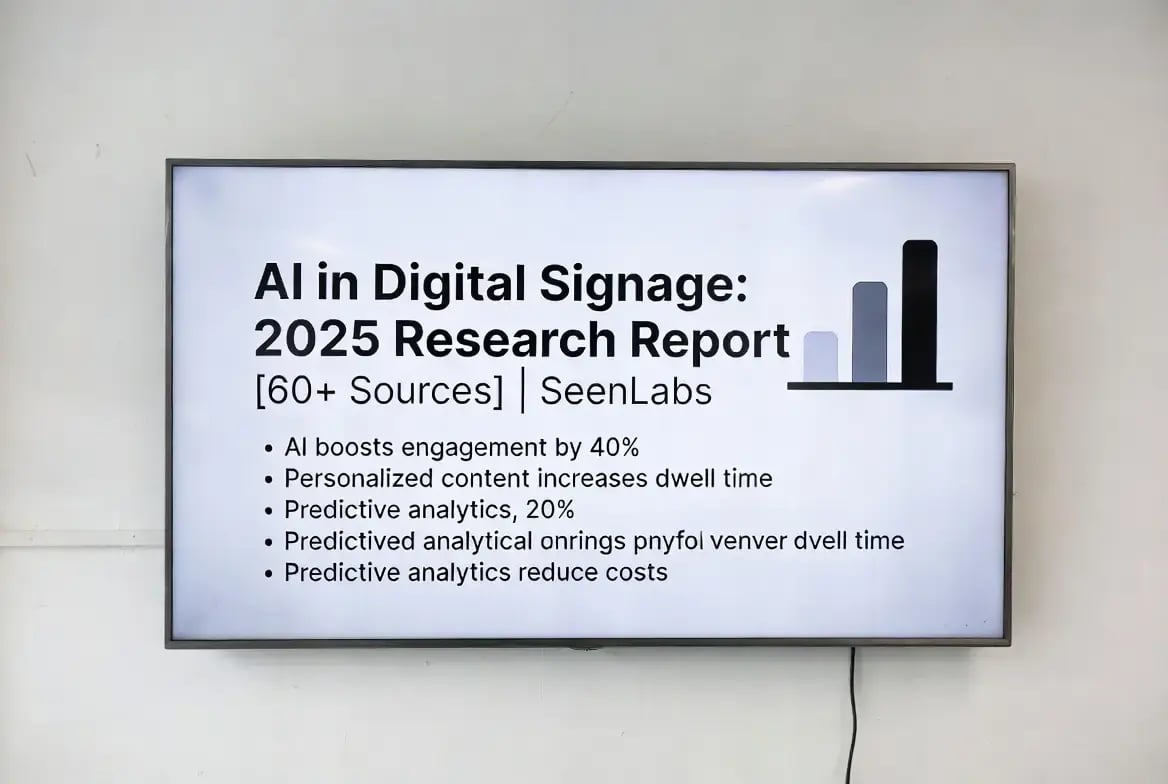
2025 RESEARCH REPORT
AI in Digital Signage: Current Deployments and Future Outlook
A comprehensive analysis of artificial intelligence applications in digital signage networks, featuring 60+ industry sources, real-world case studies, and strategic recommendations.
+24%
Sales Lift with AI Analytics
2×
Higher Dwell Time
83%
Recall Improvement
60+
Sources Cited
📑 Table of Contents
AI-Powered Personalization in Digital Signage Networks
Real-World Deployments
Major brands have begun tailoring digital signage content to context and audience in real time. McDonald's, for example, deployed an AI-driven menu decision system across 12,000+ U.S. drive-thrus and kiosks after testing in 2018. Using the Dynamic Yield platform, McDonald's screens automatically recommend menu items based on factors like time of day, current restaurant traffic, and item popularity. This personalization layer boosted "Recommended" and "Suggestive Sell" performance – increasing average check sizes by surfacing more relevant upsells.
Another deployment, Innovative Foto, added computer vision audience analytics to mall photo kiosks: after a week of measuring viewer demographics and dwell time, they adjusted screen content to better target the actual audience. The result was a 24% jump in vending sales of photo prints. These cases illustrate how AI-driven content optimization can translate into measurable lifts in engagement and revenue.
Dynamic Contextual Content
Personalization often leverages live data feeds. Retailers and DOOH (digital out-of-home) networks use triggers like weather, location, and demographics to choose content. For instance, programmatic DOOH systems can serve ads "based on conditions such as time of day, weather, and audience demographics" in real time. A QSR might advertise cold drinks on a hot afternoon or feature a breakfast item in the morning.
Early implementations show promise: one study found digital displays with dynamic content can lift recall by up to 83% over static signage. By integrating inventory and POS data, screens can even swap out promos when items go out-of-stock or when certain products need a push. This level of contextual relevance makes signage more responsive to the environment, aiming to increase viewer relevance and conversion (e.g. sales uplift of 20–30%), as reported in various retail pilots.
Performance Metrics
Hard metrics are still emerging, but case studies are encouraging. A fast-food chain in NYC saw targeted digital menu boards increase sales by 8–12% after fine-tuning content to local customer preferences. In shopping malls, a controlled experiment by Quividi demonstrated that ads matched to audience gender/age in real time drove 2× higher attention time than non-targeted ads.
Brands report that personalization is improving engagement (e.g. 40% higher dwell time in one mall signage test) and yielding better ROI on signage content. Overall, AI-fueled personalization is moving beyond pilots into mature deployments that deliver quantifiable benefits in the U.S. market.
Generative AI for Scalable Content Creation
Tools and Workflows in Use
Generative AI – including text, image, and video generation – is now being leveraged to produce signage content at scale. Specialized CMS vendors have integrated these capabilities. For instance, NoviSign's digital signage platform features an AI Image Generator that creates custom visuals from simple text prompts, directly within the content editor. Marketers can type "freshly baked pizza with cheese" and instantly get a professional-looking image to use on a menu board.
This built-in tool, powered by generative models, lets non-designers produce on-brand graphics in seconds and update screens faster. Similarly, Mandoe Media launched an "AI Magic Content Generator" for small businesses, which can take a plain prompt (e.g. "Double cheeseburger Friday special $18") and output a ready-to-use sign layout with appealing copy and imagery. These solutions dramatically reduce creative production time – marketers can generate variations of ads or localized content without always outsourcing to designers.
Adoption by Vendors
In addition to signage-specific platforms, many creative and ad tech vendors are embracing generative AI. Large agencies (WPP's Hogarth, etc.) have stood up GenAI studios that blend machine generation with human creative direction. They use tools like OpenAI's GPT for copywriting and Midjourney or DALL·E for imagery to produce countless ad adaptations for different screen formats.
According to a Salesforce survey, 51% of marketers are already using or experimenting with generative AI, and ~75% plan to adopt it soon. This trend is visible in digital signage: content teams use AI to quickly create multilingual text, auto-resize designs, or even generate short video clips.
🎬 CASE STUDY: COCA-COLA 2024
Coca-Cola's 2024 holiday campaign used an AI-generated video ad, tapping cutting-edge generative models for animation. While that sparked some creative debate, Coca-Cola reported the AI-assisted ad "scored off the charts" in consumer tests and drove strong conversion metrics. The workflow involved human creatives guiding the AI output (storyboards, style prompts) and then polishing the result – a template for how generative AI is being adopted commercially.
At-Scale Content Personalization
Generative AI also enables mass personalization of signage creative. Instead of one-size-fits-all campaigns, brands can algorithmically generate hundreds of ad variants tailored to different demographics, locations, or times. A retail chain might use a template prompt ("50%-off {Product} sale for {City}") and have AI render unique graphics for each store region with appropriate imagery (snowy backdrop for Denver, sunny for Miami, etc.).
This approach, using AI to localize and refresh content continuously, is becoming feasible and is used by digital-out-of-home networks aiming to keep content hyper-relevant. Yodeck and Intuiface have published guides on using GPT and DALL·E to automatically update screen messages based on live data feeds. For instance, generative text models can draft new promotional captions each morning (varying tone and length by audience), while generative image models produce visuals for events (e.g. "spooky Halloween sale banner") on the fly.
These workflows are in active use, though usually with human approval in the loop. The key vendors providing such capabilities include OpenAI (via API integrations), Adobe (Firefly generative suite for designers), and niche startups like DeepSign or Marquise focusing on AI video for DOOH. The commercial consensus is that generative AI can drastically cut content production costs and time (marketers expect it to save ~5 hours per week), but it works best as an assistant – generating drafts or assets that humans then curate for quality and brand fit.
Predictive Analytics and Reinforcement Learning for Content Optimization
Real-Time Playlist Optimization
Beyond static schedules, AI is used to dynamically optimize which content plays when. Predictive analytics models analyze historical data (e.g. sales, foot traffic patterns, ad performance) to forecast the optimal content schedule for a given period or context. For example, a fashion retailer's system might predict higher effectiveness for running shoe ads on weekday evenings (when gym visits spike) and automatically adjust the playlist accordingly. These predictions consider multi-variable patterns that humans might miss.
In digital signage, reinforcement learning (RL) is emerging as a technique to continuously fine-tune content sequencing. An RL agent can treat each content slot as a decision and learn from feedback – such as viewer dwell time or sales lift – which sequences maximize a reward (like engagement). Over time, the system "learns" the best mix of content for each screen context.
📊 INDUSTRY EXAMPLE: FUGO.AI
Fugo.ai (a signage software firm) describes implementing time-series models and RL to learn which content sequences maximize KPIs like dwell time and conversions. Their approach involves deploying lightweight ML models on media players that can quickly decide the next ad based on live audience response, while a cloud brain does heavier strategy optimization. This kind of adaptive scheduling is moving from concept to reality in enterprise deployments.
Adaptive Campaigns Based on Data Signals
Several networks now utilize streams of data to trigger instant content changes. Viewer behavior is a key signal: anonymous computer vision can estimate a viewer's age/gender/emotion, and signage CMS will then pick the most relevant ad copy for that demographic in real time. A partnership between Quividi (audience analytics) and a mall operator showed that using real-time pattern detection to match ad content to the present audience doubled engagement compared to static loops.
Other signals include sales and inventory data – e.g. a convenience store's system might promote umbrellas on the signage when inventory is high and rain is forecast, or stop promoting an item that is running low in stock. Weather and traffic data likewise inform content: quick-service restaurants have used predictive models to suggest hot drinks on cold days or to simplify menus when drive-thru queue lengths are long, improving throughput.
These adaptive strategies often use a rules-based layer (for obvious correlations like weather) combined with machine learning that uncovers subtler correlations (for instance, a model might learn that lunchtime digital promos for certain snacks work best on Fridays, boosting end-of-week impulse buys).
Reinforcement Learning in Practice
While full RL autonomously running a signage network is still early-stage, some pilots hint at its potential. One convenience chain tested an RL-driven system on a digital end-cap display: the AI would try different product ads and receive a "reward" based on sales increases in the next hour. Over a few weeks, the system identified high-performing content sequences (e.g. pairing a snack ad after a beverage ad led to more combo purchases) and rearranged the playlist to exploit those pairings. This experimental setup reportedly improved basket size by a few percentage points versus the old static rotation.
Similarly, enterprise platforms like NEC's ALP (Analytics Learning Platform) were designed to ingest camera analytics and auto-adjust content in real time – for example, showing a promotion when a threshold of target audience is present. One challenge has been ensuring these AI decisions are fast and reliable: signage has to respond in milliseconds to a trigger (like someone walking by) without glitches. Techniques like on-device inference (TinyML models running directly on media players) are used to avoid cloud latency.
In summary, predictive and adaptive content optimization is becoming a hallmark of "smart" signage systems. Early adopters report improved targeting and higher ROI, though careful A/B testing is needed. In McDonald's case, every drive-thru screen algorithm is A/B tested against an alternative to ensure uplift before fully rolling out a change. This human-in-the-loop validation is critical when algorithms orchestrate customer-facing content.
Regulatory and Ethical Constraints (Privacy, Bias, Transparency)
Privacy Laws and Camera Analytics
The use of AI in signage – especially camera-based audience insight – raises significant privacy considerations. In the U.S., there is no single federal law banning facial analysis in public, but state laws and public sentiment impose limits. Illinois's BIPA (Biometric Information Privacy Act) is the strictest example: it prohibits capturing biometric identifiers (like face scans) without consent, exposing violators to hefty fines. Signage operators in Illinois (and locales with similar rules) must ensure any video analytics are truly anonymous – no storing of images or uniquely identifying data.
To navigate this, companies like Quividi and DISPL design their systems such that video is processed on-device and no face images or personal data are recorded or retained. The analytics output (counts, demographic categories) is aggregated and cannot be traced to individuals, keeping it largely outside personal data definitions.
Transparency is another emerging requirement: venues deploying AI-enhanced signage often display notices or decals informing customers that anonymous video analytics or sensors are in use. This is both an ethical practice and a hedge against legal risk, as privacy regulators favor clear disclosure of any data collection. In Europe, under GDPR, even anonymous analytics can be considered personal data if there's any chance individuals are singled out. U.S. companies, anticipating similar standards, are voluntarily adopting elements of GDPR compliance – for instance, giving opt-outs for interactive signage or avoiding sensitive categories of data altogether.
Algorithmic Bias and Fairness
AI that drives content selection must be monitored for bias. Demographic targeting can become problematic if not handled carefully – e.g. if an algorithm shows luxury ads only to a certain race, or assumes gender in a way that reinforces stereotypes, it could alienate customers and invite PR or legal issues.
The advertising industry is well aware of this risk: 69% of marketers in one survey cited concerns about AI bias and are instituting safeguards. Many U.S. brands and agencies have internal AI ethics guidelines that prohibit targeting on protected characteristics (race, religion, etc.) or require human review for any automated segmenting that could be sensitive.
In digital signage context, this means AI might use broad audience metrics (age group, context) but avoids making discriminatory inferences. Technical tools are also emerging to check bias – IBM's AI Fairness 360 or Google's Fairness Indicators can audit models for skew. For a signage AI recommending content, an explainability layer is often added: the system can log why it showed a particular ad (e.g. "rule triggered: rainy weather = display umbrella ad"). This helps ensure there's a rational, non-discriminatory basis for content decisions if questioned. It also aids compliance with any future regulations that may require explaining automated decisions.
Regulatory Compliance and Industry Standards
Although the U.S. lacks a blanket AI law, companies are guided by a patchwork of sectoral rules and self-regulation. The FTC has warned against "snake oil" AI in marketing and will act if algorithms deceive consumers or violate privacy promises (for example, claiming no data is collected when it is). Industry bodies like the Digital Signage Federation and DPAA have published best practices urging privacy-by-design (anonymize data at source, get opt-in for any personalized marketing) and content standards for AI-generated ads.
Notably, the EU's AI Act (forthcoming) is influencing multinationals – it classifies biometric identification and emotion recognition as "high-risk" AI uses. U.S. vendors who operate globally, like Intel's anonymous viewer analytics or Cognovision, have preemptively built compliance modes (turning off or blurring camera feeds in EU regions, etc.).
We also see California's privacy laws (CCPA/CPRA) starting to cover in-store data: if camera analytics data is linked with other customer data (say, loyalty programs), it could count as personal info requiring disclosure and opt-out. As a result, many U.S. retail deployments stick to anonymous, aggregate metrics and purge data frequently to avoid creating troves of personal data.
⚠️ CAUTIONARY TALE: WALGREENS SMART COOLERS
In summary, regulatory constraints are shaping AI in signage by pushing it toward anonymous, transparent, and well-audited implementations. Companies that ignore these issues face risks – not just legal, but reputational. Public backlash killed some projects like Walgreens' smart coolers, where customers felt spied on and the tech was deemed "frustrating" and even "potentially dangerous" by Walgreens in terminating the project.
Balancing Automation and Human Creative Control
Expert Viewpoints
Across the advertising industry, there is a strong consensus that AI is a powerful tool for efficiency and personalization, but not a replacement for human creativity and oversight. As one digital signage marketing report put it, "most campaigns that move audiences have a common denominator: creativity – something AI is not capable of [alone]."
AI can crunch data and even generate content drafts, but humans provide the cultural context, brand voice, and creative spark that make campaigns resonate. Over-automating the creative process can lead to tone-deaf or off-brand outputs, which is why experts advocate a hybrid workflow. Richard Glasson, CEO of WPP's Hogarth, observed that the rise of generative AI has "only increased the importance of craftsmanship," leading his agency to pair machine efficiency with human-led art direction in new GenAI studios. In practice, this means AI might generate 100 banner variations, but creative directors still curate the best ones and refine messaging. Such human quality control is crucial to prevent the pitfalls seen in recent AI-only campaigns.
When Over-Automation Fails
There have been several high-profile missteps where brands leaned too heavily on AI without proper oversight:
These incidents underscore that audiences notice and punish careless AI shortcuts. They also highlight an irony: in sectors like retail and fashion, where brand heritage and trust matter, obvious synthetic content can do more harm than good. The lesson is that automation should never outrun human judgment. AI can generate content at scale, but "using [AI] and using [it] correctly are two different things".
Successful Hybrid Approaches
On the positive side, many organizations have found the sweet spot by using AI to augment, not replace, their creative workflows. For instance, Coca-Cola's marketing VP noted that their AI-generated holiday ad still had human creatives steering it – and they simultaneously produced a traditional ad in the same campaign to maintain a human touch. This balanced approach allowed Coca-Cola to be innovative and avoid alienating those who crave the classic emotive storytelling.
Agencies now routinely use AI for the grunt work (resizing assets, basic copy, versioning) while reserving final creative decisions for humans. The IAB recommends treating generative AI as an "accelerator rather than a wholesale replacement" for creative teams. By blending machine output with human refinement, brands can achieve personalization and volume without sacrificing authenticity or quality.
Notably, the failures of over-automation have prompted stricter review processes – many brands have instituted mandatory human approval for any AI-produced content before it goes live, no matter how minor. The emerging best practice: let AI do the heavy lifting on data and variations, but keep humans in charge of strategy, narrative, and final polish. This ensures technology serves the creative vision, and not the other way around.
AI Roadmap: The Next 3–5 Years (2025–2030)
In the near future, AI is expected to become deeply embedded in digital signage operations, though still under significant human guidance:
🎯 Wider Deployment of Personalization Engines
What is cutting-edge today will be standard in a few years. We will see more retail chains and networks deploying AI personalization at scale – e.g. grocery stores using computer vision to tailor end-cap screen ads to the shopper's profile (with privacy-safe methods). Quick-service restaurants beyond McDonald's will adopt dynamic menu boards that adjust in real time to factors like wait times, weather, or nearby events. These deployments will be buoyed by continued evidence of ROI, and by cheaper, more powerful edge AI hardware (making it cost-effective even for mid-sized businesses). In 3–5 years, a majority of new digital signage installations in the U.S. will come "AI-ready" out of the box.
🎨 Generative Content On-Demand
Generative AI will mature as a creative assistant. We anticipate mainstream use of generative models in content management systems – for example, a signage manager could say, "AI, create a Labor Day sale ad with a BBQ theme," and the system will produce a ready-to-deploy graphic and slogan. Routine content updates (daily specials, localized messages) will be almost fully automated. Human designers will shift to higher-level roles: curating AI outputs and focusing on big creative concepts. The speed and scale of content refresh will increase; digital signs might get new AI-generated content weekly or even daily to prevent ad fatigue. This will especially benefit large networks needing hundreds of localized variants. Workflows will also become smoother as vendors integrate these tools – expect partnerships like CMS + OpenAI or Adobe such that users might generate or edit signage content via natural language prompts within their scheduling software.
📊 Real-Time Analytics Feedback Loops
The next few years will see more closed-loop systems where signage performance data instantly feeds back to AI algorithms. Cameras or sensors will monitor viewer engagement (dwell time, gaze) and automatically tweak content scheduling or triggers. This could approach a real-time A/B/n testing cycle: the system might continuously experiment (showing Option A vs B creative) and swiftly allocate more screen time to the better performer. Reinforcement learning agents might start governing limited aspects of playlists in high-traffic locations, where there's enough data to learn quickly. However, humans will still define guardrails for these algorithms (business rules, brand safety constraints) and step in if anomalies occur.
🔒 Enhanced Privacy and Opt-In Models
Given the regulatory trajectory, by 2030 we expect stronger privacy measures in U.S. digital signage. Opt-in loyalty integrations might emerge – for instance, shoppers install an app and consent to personalized offers, then nearby digital signs can recognize the app's ID (via Bluetooth or NFC) and show a personal deal (loyalty price, birthday promo, etc.). This would be a privacy-compliant way to achieve one-to-one personalization, as users actively agree to it. Camera analytics will continue, but likely remain anonymous-only in the U.S. (particularly if federal laws or more state laws restricting biometrics pass). We also foresee the industry adopting transparency standards – digital signs might display a small decal or info button like "Why am I seeing this?" allowing users to understand at a high level that AI selected the content based on non-personal data. Balancing innovation with privacy trust will be a key theme of the next 5 years.
🤖 More Intelligent Content Scheduling (AI + Human Collaboration)
Content planning for signage campaigns will increasingly rely on predictive analytics. Marketers will use dashboards where AI suggests the optimal content mix for the next week or month based on forecasted customer behavior. This could include seasonal AI models (predicting what creative themes will resonate each month) and inventory-linked models (ensuring signage pushes products that align with supply). While humans will approve and adjust these plans, much of the number-crunching and recommendation generation will be automated. The outcome should be higher efficiency (less guesswork in scheduling) and better business alignment (signage that flexes with operations and marketing goals in near-real time).
AI Roadmap: The Next 7–10 Years (2030–2035)
Further out, AI's role in digital signage could become truly transformative, potentially reshaping the concept of "content" itself:
Fully Autonomous Content Optimization
With a decade of data and algorithm improvements, we could see signage networks where AI autonomously manages content selection and even creation end-to-end. Reinforcement learning agents, given clear objectives (e.g. maximize engagement or sales lift) and constraints (brand guidelines, compliance rules), might run continuous optimization loops. These agents would ingest a rich array of signals – from real-time store sensors to big data like local events or social media trends – and dynamically serve what history proves most effective for the current context.
For example, a digital billboard in 2032 might analyze traffic patterns, social media sentiment, and audience composition in milliseconds and then concoct a custom ad (via generative AI) targeted to that moment. Such on-the-fly generation of content tailored to micro-moments could become feasible. This is an extension of today's programmatic DOOH, but far more granular and AI-driven. Importantly, human oversight will remain (especially for brand-sensitive matters), but the heavy lifting of decision-making could be machine-run at scale, across thousands of screens, adapting continuously.
Deeper Personalization (One-to-One and Immersive)
By 7–10 years from now, the line between personal device and public display may blur. It's conceivable that AR glasses and digital signage will interact – signs could deliver augmented content that appears differently to each viewer (as their AR wearables overlay personalized info). Even without AR, digital signs might identify opt-in individuals via their mobile devices and change content specifically for them.
For instance, a loyal customer walking into a store might see a "Welcome back, [Name]" message or personalized sale on a lobby screen (assuming they consented via an app). While mass one-to-one targeting in public spaces will be gated by privacy norms, younger consumers in 7–10 years may be more accustomed to opting in for convenience and deals. Facial recognition for personalization might remain limited in the U.S. due to legal restrictions, but alternative tech (device-based IDs, loyalty apps) could enable similar tailored experiences. Overall, expect a much greater personalization granularity – content might not just segment by broad demo, but by individual preferences, purchase history, or even real-time emotional state (e.g. a smart fitting-room screen shows different outfit recommendations if it senses frustration vs. delight).
Generative AI Dominates Content Production
By 2035, a significant portion of digital signage content could be AI-generated or AI-assisted. Generative AI models by then (several generations beyond today's GPT-4/Stable Diffusion) will be far more advanced, likely capable of producing high-quality video and 3D content on demand. This means brands can automate the creation of short video ads or interactive avatars for kiosks with minimal human labor.
We might see virtual AI "spokespersons" on screens – for example, a hyper-real avatar that can engage customers in natural language, answer questions, and promote products (drawing from a generative language model). Content refresh could be continuous; instead of set campaigns, AI could maintain a perpetual creative evolution – always testing new visuals, new copy, learning from responses, and never "going stale." Human creatives will focus on high-level storytelling, brand identity and supervising these AI content engines, possibly curating occasional major campaigns to ensure a cohesive narrative.
Integration with Other Emerging Tech
In the 7–10 year horizon, AI in signage will converge with IoT, 5G, and smart city infrastructure. Digital signs will be nodes in larger smart environments, pulling data from city sensors or vehicles to tailor messages (think digital billboards that adjust not just to who is looking, but to the context of an entire area's activity). AI will help orchestrate this complexity – perhaps a city-wide AI coordinates content across hundreds of public displays in real time, aligning messaging during an emergency or optimizing ads when big events swell crowds.
Augmented reality and mixed reality experiences might also be delivered via digital signage with AI mediation – e.g. interactive wayfinding displays that use computer vision to guide individuals (in multiple languages, translated on the fly by AI). Essentially, AI will be the connective tissue making signage more interactive, conversational, and seamlessly integrated into everyday life. Ethically, this future will demand robust governance – ensuring these powerful capabilities aren't used in manipulative or invasive ways will be paramount, and likely formalized by regulations by that time.
Regulations and Standards Mature
By 2035, we anticipate clear regulatory frameworks in the U.S. for AI in advertising (if not sooner). This could include required auditing of algorithms for bias, mandated transparency for personalized content ("AD" indicators or context labels on AI-generated content), and updated privacy laws that account for new identifier technologies.
Companies that invest now in ethical AI practices will be well-positioned when these standards solidify. It's possible we'll see industry-wide opt-in programs or "trusted AI" certifications for digital signage solutions that meet certain privacy and fairness criteria, which could become a selling point for network operators and reassure the public. In sum, a decade from now AI will be ubiquitous in digital signage, but also largely invisible and trusted – the goal being that consumers see relevant, engaging content on screens and benefit from it, without feeling their data is misused or that the "robots have taken over" the creative process.
Strategic Recommendations for Digital Signage Operators
Based on our analysis of AI adoption trends and market dynamics, we've identified key strategic priorities for digital signage operators looking to stay competitive. Whether you're a network operator, integrator, or enterprise deploying signage, these recommendations can help you build sustainable AI differentiation.
💻 Invest in Intelligent Content Software
Look for CMS platforms with AI-driven content scheduling and personalization engines. These systems should use data inputs (time, weather, audience analytics) to automate playlist decisions in real time. A "smart scheduler" that optimizes content for engagement or sales goals can significantly outperform static playlists. Start with rule-based personalization (dayparting, weather triggers) and gradually incorporate machine learning for nuanced optimization.
🎨 Leverage Generative Creative Tools
Adopt platforms that integrate generative AI capabilities for content creation. Modern tools let users generate ad copy or visuals via simple text prompts directly in the CMS. This helps produce fresh, localized content at scale without constant designer involvement. Ensure any tool you choose allows easy human editing and provides brand-safe style options to maintain visual consistency across your network.
📊 Build Your Data & Analytics Capabilities
Your signage network generates valuable data — footfall counts, content playback stats, interaction rates, and contextual performance data. Invest in analytics that aggregate this data to fuel AI-driven decisions. With sufficient first-party data, you can train predictive models for optimal content timing or create benchmarks showing clients how their content performs. Emphasize data governance: anonymize viewer analytics and implement clear data retention policies.
👥 Develop AI Expertise
Whether through hiring or upskilling, ensure your team understands AI capabilities and limitations. Key competencies include: understanding computer vision for audience analytics, familiarity with predictive models and their business applications, and ability to integrate AI APIs into existing workflows. Even a small internal AI task force can drive innovation and help you evaluate vendor claims critically.
🤝 Explore Strategic Partnerships
Partnerships can accelerate your AI capabilities. Consider integrations with camera/sensor analytics firms (Quividi, AdMobilize, Intel OpenVINO), generative AI providers (OpenAI, Google), or retail tech companies to integrate sales data. Strategic partners can enhance your product offering and open new client pipelines. Focus on partnerships that improve software features, provide unique data access, or extend market reach.
🛡️ Prioritize Ethical AI and Compliance
Differentiate by leading in responsible AI use. Build in privacy features (on-device processing, no facial recognition storage) and provide tools for regulatory compliance (auto-blur faces, configurable data retention, on-screen privacy notices). A "privacy-first" positioning alleviates client concerns in sensitive industries like healthcare or banking. Incorporate bias testing and maintain transparency about how AI makes content decisions.
Implementation approach: Start with focused pilots — roll out AI content features to a handful of beta locations, gather feedback, and measure impact before scaling. Use successes as case studies (with metrics) to demonstrate value. Foster a culture of experimentation and learning, so your team iterates quickly and stays ahead of the competition. The goal is making AI a practical, results-driven capability that improves signage effectiveness.
Ready to Implement AI-Powered Signage?
SeenLabs offers turnkey digital signage solutions with intelligent content management capabilities.
Explore Solutions Book a Demo❓ Frequently Asked Questions
📚 Sources & References
This research report cites 60+ industry sources including:
- McDonald's Dynamic Yield case (Mastercard)
- Quividi/Innovative Foto study (DPAA)
- NoviSign AI documentation
- Mandoe Media AI Content Generator
- Fugo AI signage whitepaper
- IAPP: Ethical use of AI in advertising
- eMarketer: AI campaign failures analysis
- DISPL privacy compliance insights
- Coca-Cola generative AI campaign (Marketing Dive)
- Intuiface: Generative AI in Digital Signage
- Walgreens smart cooler case
- TouchSource: Future of AI in Signage