Published February 25, 2026 · By Vlasov Edward · SeenLabs
Forty-eight nations. Ten million international visitors. Six weeks.
The 2026 FIFA World Cup starts June 11 in the United States — the first time the country has hosted the tournament since 1994. This version is double the scale: 104 matches across 11 US cities, compared to 52 matches in 9 cities three decades ago. Over half a billion ticket requests have already been submitted. The top requesting countries after the US, Mexico, and Canada? Colombia, England, Ecuador, Brazil, Argentina, Germany, and France.
Most of these fans don't speak English as a first language. And research consistently shows that when a customer can't read your menu, they leave.
This isn't a hospitality nicety. It's a revenue decision — one that restaurant owners in Dallas, Houston, Miami, Kansas City, and every other host city need to make before June.
Key Takeaways
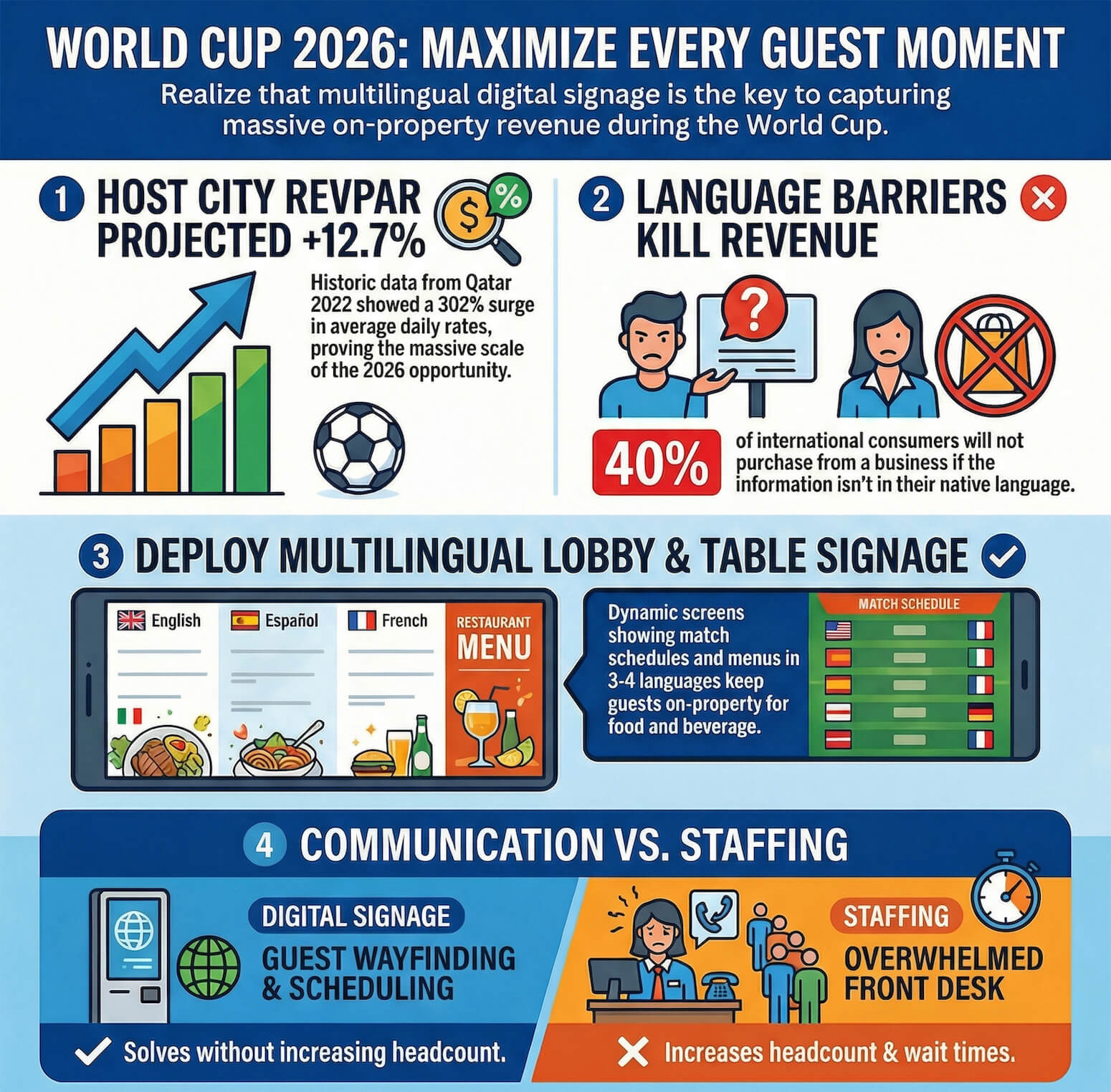
According to CSA Research, 40% of consumers never purchase from businesses that don't communicate in their language
Cornell University's School of Hotel Administration found multilingual menus increase average spend by up to 26%
Spanish is needed in 8 of 11 US host cities; Portuguese in Miami and NY/NJ for Brazil fans
Static printed menus can't switch languages by match — dynamic displays can
The Language Math: What Happens When Customers Can't Read Your Menu
40%of consumers never purchase from a business communicating in the wrong language (CSA Research)
+26%average spend increase when menus are available in a customer's native language (Cornell Hospitality)
28%of international travelers say language barriers hold them back from spending (Booking.com)
Read those numbers together. According to CSA Research, four out of ten international visitors will not order from your restaurant if they can't read your menu. According to Cornell University's School of Hotel Administration, the ones who do stay and order in their own language spend 26% more on average. And roughly a quarter of all international travelers actively avoid destinations and businesses where they expect a language barrier.
Now apply that to the 2026 World Cup. Of the projected $556 million in US host city visitor spending, $280 million — half — goes to food and beverage. That's the largest single category. If your restaurant is in a host city and 40% of the international foot traffic walks past because your menu is English-only, the math is straightforward: you're leaving revenue on the sidewalk.
The Super Bowl frame: A Super Bowl brings roughly 100,000 visitors to one city for one week. The 2026 World Cup brings 10 million visitors to 11 cities over 39 days. In Dallas alone — 9 matches, $2+ billion in projected economic impact — the Spanish-speaking fan contingent from Mexico, Colombia, and Argentina will be the dominant international group. Picture 9 Super Bowls' worth of foot traffic, and most of it navigating your neighborhood in Spanish.
Which Languages, Which City: The Host-by-Host Breakdown
Not every host city faces the same linguistic mix. The most-requested matches reveal where fans are traveling — and what languages they'll be speaking when they arrive. Here's the breakdown based on FIFA ticket request data and scheduled matchups:
Host City
Primary Languages Needed
Key Fan Origins
Dallas
Spanish (heavy), English
Mexico, Colombia, Ecuador, Argentina
Houston
Spanish, English
Mexico, Colombia
Miami
Spanish, Portuguese
Colombia, Brazil, Portugal, Argentina
Kansas City
Spanish
Argentina, Mexico
New York / NJ
Portuguese, French, German, English
Brazil, France, Germany, England, Scotland
Los Angeles
Spanish, Korean, English
Mexico, Korea, USA
Seattle
English, French
USA, England, Scotland, France
Atlanta
Spanish, English
Colombia, USA
Miami is hosting Colombia vs Portugal on June 27 — the single most-requested match globally. That means massive simultaneous Colombian (Spanish) and Portuguese fan populations converging on the same city for the same match. A restaurant in Miami serving match-day dinner in English only is invisible to the majority of the crowd walking by its door.
Dallas and Houston — between them hosting 16 matches — will see the heaviest Spanish-language concentration of any host cities. Kansas City, despite being the smallest host market, draws Argentina on June 16, meaning a concentrated, high-spending wave of Spanish-speaking fans in a city that may not be built for that.
A fan who flew from Bogotá to Miami for Colombia vs Portugal is not a budget traveler. They're spending. The only question is whether they're spending at your restaurant or the one next door that has a menu they can read.
The 25% Who Got Nothing — and What Language Had to Do With It
The NYC Hospitality Alliance surveyed more than 130 restaurants and bars after the 2022 World Cup. While 75% reported increased revenue, 25% saw no meaningful benefit — despite the same fan traffic flowing through their neighborhoods.
The common factor among the underperformers: they weren't visibly set up for international visitors. No visible match viewing. No multilingual signage. No communication that said "we welcome you — in your language."
The displacement effect: the economic phenomenon where mega-event spending doesn't increase total revenue — it redistributes it from unprepared businesses to visibly prepared competitors. Documented by Clemson University researchers studying economic patterns at major sporting events.
The displacement effect: Clemson University research on mega-events shows that spending during tournaments doesn't evenly distribute — it shifts toward businesses that actively prepare. Restaurants that don't adapt lose traffic not to the tournament itself, but to competitors who do adapt. The World Cup doesn't automatically benefit every restaurant in a host city. It benefits the ones that are visibly ready.
The 2026 World Cup will be the largest international event the US has ever hosted. The restaurants that capture the multilingual opportunity aren't necessarily the biggest or best-located. They're the ones where a Colombian fan, a Brazilian supporter, or an Argentine family walks in, sees a menu they can read, and stays.
Static Translation vs. Dynamic Menu Switching: Why One Works
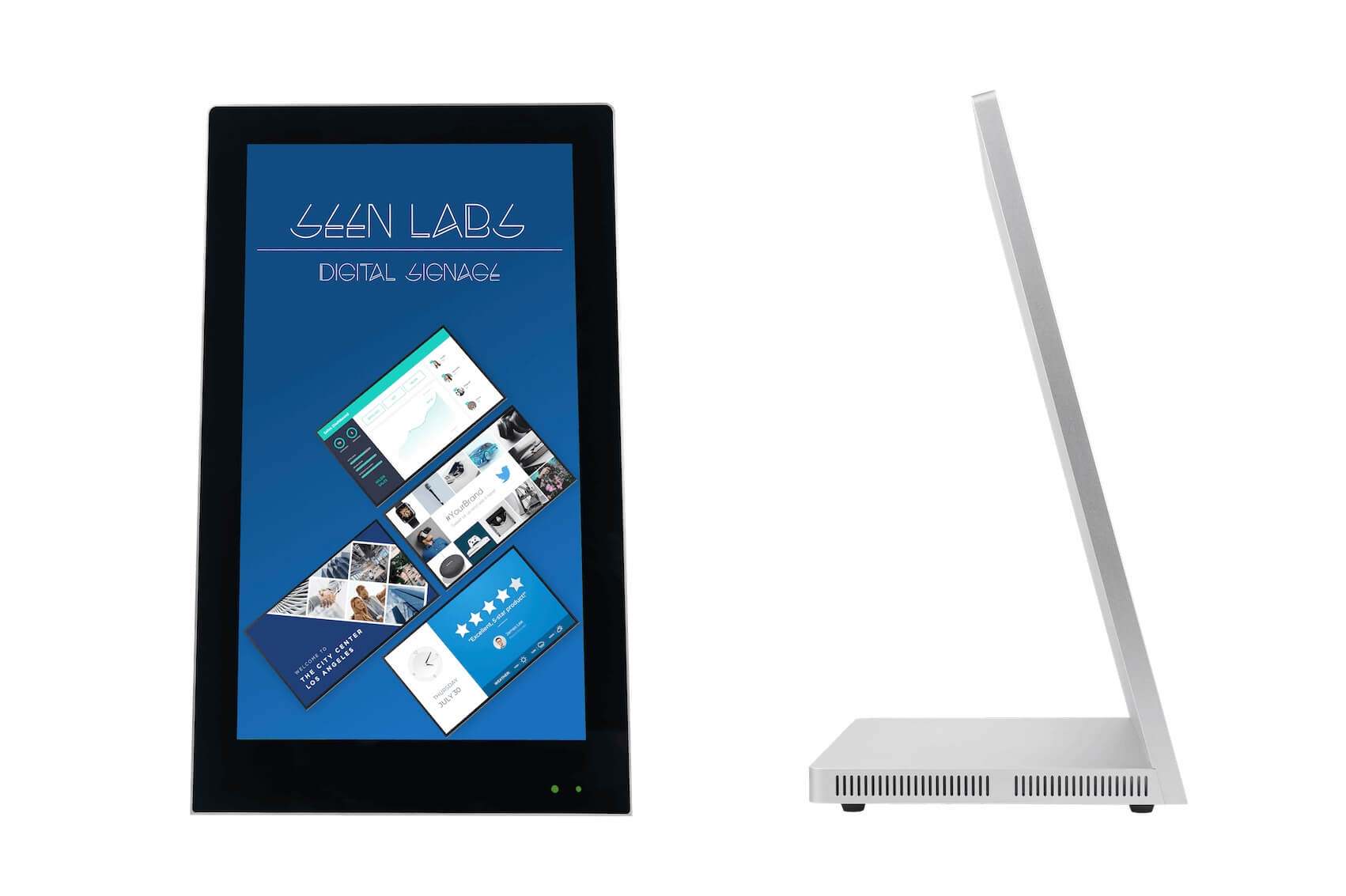
A digital table tent displaying menu content. In a multilingual configuration, the same unit rotates between languages automatically — or a staff member switches it in seconds.
The traditional solution to language barriers is printing translated menus. It works — partially. But it breaks down during a World Cup for specific reasons:
Static printed translations
Fixed at print time — can't update prices, specials, or seasonal items
One language per menu; multiple versions create inventory chaos
Staff must identify which language a customer needs and deliver the right version
No match-day specials integration — requires reprinting
Wear and tear over 39 days of heavy tournament traffic
Digital multilingual switching
Update prices, add specials, change items in real time
One device, multiple languages — rotate automatically or switch on demand
Staff taps a button; language changes in seconds
Match-day promotions pushed to every table simultaneously
Same device works for 39 tournament days and 365 days per year after
During a 39-day tournament with matches every day and different fan demographics arriving for each match, the static approach doesn't scale. On June 16, Kansas City serves Argentine fans needing Spanish. On June 25, New York serves Ecuadorian fans needing Spanish and German fans needing — well, most will manage in English, but the point stands: the language mix shifts match by match, sometimes day by day.
A digital table tent solves this by making language a content variable, not a physical inventory problem. The restaurant owner or manager switches the language from a dashboard. Every table updates simultaneously. No reprinting, no staff sorting through stacks of laminated menus.
Missouri Already Did It: What "Lingo Eats" Tells Us About Industry Direction
According to KCTV5 News (February 2026), the Missouri Restaurant Association launched "Lingo Eats" — an AI-powered multilingual menu translation app built specifically for World Cup 2026. It supports 28 languages and was created to help restaurants in Kansas City (a host city with 6 matches, including Argentina on June 16) serve international visitors.
This is significant for three reasons:
An industry association built a tool from scratch. When a state restaurant association invests in multilingual infrastructure specifically for the World Cup, it signals that the industry views language barriers as a serious revenue risk — not a theoretical concern.
28 languages, not 2 or 3. The scope reflects the reality that 48 nations' worth of fans will travel to US host cities. Spanish alone isn't enough in New York (Portuguese, French, German) or Los Angeles (Korean, Spanish).
The timing is deliberate. Launching in February 2026 — four months before the tournament — gives restaurants time to integrate and train staff. The window for preparation is now, not June.
Lingo Eats solves translation. It doesn't solve display. A translated menu still needs to reach the customer at the table, at the right moment, in the right language for the specific fan group seated there. That's where the digital table tent fills the gap: it's the delivery mechanism for multilingual content, updated in real time, at every table simultaneously.
The combination: Translation tools like Lingo Eats handle the language conversion. A digital table tent handles the delivery — pushing the right language to the right table at the right time. Translation without delivery is a PDF nobody downloads. Delivery without translation is a screen nobody can read.
The Match Schedule as Your Content Calendar
One of the underappreciated advantages of the World Cup for restaurant operators: the schedule is known. Every match, every team, every city — published months in advance. That means you can plan your multilingual content rotation before the first ball is kicked:
Map your city's matches to fan languages — use the table above to identify which language is primary for each match day
Build base templates per language — Spanish menu, Portuguese menu, French menu. Build once, reuse for 39 days
Program match-day switching — Argentina match on June 16? Spanish menu goes live at 3 PM. Brazil vs Morocco on June 13? Portuguese rotates in for NY/NJ
Add match-specific specials — a Colombian coffee cocktail for June 27 in Miami; an Argentinian empanada special for Kansas City on June 16. These don't need a printing cycle — one content update pushes to every table
Run language rotation during mixed-fan matches — when no single nationality dominates, rotate languages every 30–60 seconds so every seated group sees their language at least once per rotation cycle
With a managed digital signage system like SeenLabs, this entire calendar can be pre-loaded. Templates go in once. The schedule drives the switching. Staff involvement on match day is minimal — if anything, a single tap to confirm the language for today's crowd.
How many languages should my restaurant support during the World Cup?
Start with your city's primary fan languages. For Dallas and Houston, Spanish is the highest-impact addition. For Miami, Spanish and Portuguese. For New York/NJ, Portuguese and French cover the largest international contingents. Most restaurants will see 80%+ of their international visitors covered by adding just one or two languages to English.
Do I need to translate my entire menu, or just key items?
At minimum, translate your top 15–20 items and any specials. International visitors don't need every modifier explained — they need enough to order confidently. A digital menu system lets you start with core items and expand over time without reprinting anything.
What's the difference between a translation app and a digital menu system?
Translation tools convert your menu text into other languages. A digital menu system — like a table tent — delivers that translated content to customers at the table, in real time, and lets you switch languages, update specials, and run promotions without staff intervention. One handles language; the other handles delivery. Both are needed for a complete solution.
Is the multilingual investment useful after the World Cup ends?
Yes. The 2026 World Cup is a catalyst, but multilingual menus have permanent value. The US has 42 million native Spanish speakers. International tourism continues year-round in cities like Miami, New York, and Los Angeles. Cornell Hospitality's +26% spend increase with multilingual menus applies beyond tournament season — it's a permanent revenue lever.
How far in advance should I set up multilingual menus for the World Cup?
Now. The Missouri Restaurant Association launched Lingo Eats in February 2026 — four months before the tournament — because translation, content setup, and staff training take time. Digital signage hardware procurement and installation typically takes 2–4 weeks. If you're planning for a June 11 start, orders placed by late April give you a reasonable setup runway.
Sources & References
CSA Research — Can't Read, Won't Buy: Consumer Language Preferences (2020)
Cornell University School of Hotel Administration — Multilingual Menu Impact on Consumer Spend
KCTV5 News — Missouri "Lingo Eats" Program Launch, February 2026
NYC Hospitality Alliance — Post-Tournament Survey, 130+ Operators (2022 FIFA World Cup)
FIFA — Official Venue and Ticket Demand Data (500M+ requests)
Clemson University — Economic Displacement Research at Major Sporting Events
SeenLabs Digital Table Tent — Switch languages in seconds, update every table at once
Ready to serve every fan who walks through your door?
SeenLabs deploys and manages digital table tent systems with multilingual content switching. Tell us about your restaurant and we'll build a multilingual content plan for your city's World Cup matches.