2025 MARKET ANALYSIS
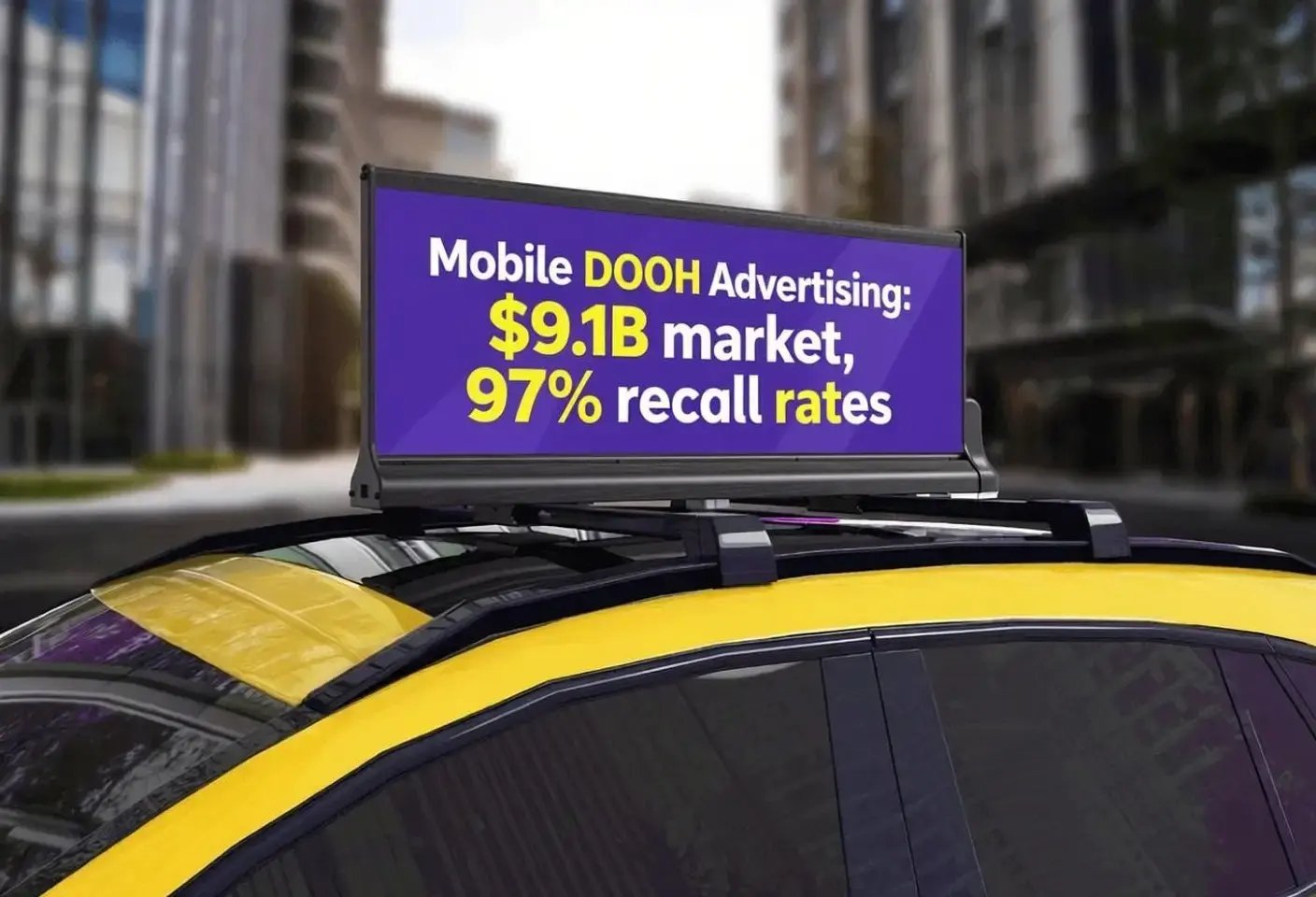
Mobile DOOH Advertising:
Vehicle-Mounted Display Networks
Complete market analysis of rideshare rooftop, taxi-top, and fleet-mounted digital advertising in the U.S.
$9.1B
U.S. OOH Market 2024
34%
DOOH Growth YoY
97%
Mobile Ad Recall
10K+
Firefly Fleet Size
📋 Contents
Market Overview: Size, Growth & Key Players
The U.S. out-of-home (OOH) advertising market reached a record high of $9.1 billion in 2024, with digital out-of-home (DOOH) making up about 34% of that spend (≈$3.1B). DOOH is growing faster than traditional static OOH – U.S. programmatic DOOH ad spend grew 34% in 2024 and is projected to grow another 23% in 2025.
$10B+
Projected by 2028
+10.6%
Transit Segment Growth
8-12%
Global CAGR Forecast
The transit advertising segment (which includes ads on vehicles and transit screens) led OOH growth with a 10.6% increase in 2024, reflecting surging interest in mobility-based advertising.
Key Players in Mobile DOOH
🔥 Firefly
Largest independent network with 10,000+ smart LED tops nationwide. Cities: Chicago, Dallas, LA, Miami, NYC, SF. ~3,000 on NYC taxis. Billions of impressions/month.
🚗 Uber OOH
Launched 2020 via Adomni partnership. Started with 1,000 screens in Atlanta, Dallas, Phoenix. Now available on programmatic exchanges.
💜 Lyft Halo
Acquired Halo Cars in 2019. Rooftop screens deployed in NYC, LA, Washington D.C. and other markets.
🚕 Other Players
Curb (taxi media), Lumos, Adflow (independent car-top/in-car networks). Competitive and growing arena.
Common Business Models
Media Network Ownership
Companies own/operate screen fleets OR partner with third parties. Uber/Lyft leverage drivers' cars while controlling the media platform. Firefly provides hardware + ad platform.
Revenue Sharing with Drivers
Drivers earn supplemental income:
- Firefly: ~$300/month (40+ hrs/week)
- Uber: $300 upfront + $100/week
- Lyft Halo: ~$400/month
Programmatic Sales
Networks integrate with DSPs (Adomni, Vistar, Place Exchange). Self-service buying by location/time. Dynamic pricing. Omni-channel ad buys where mobile DOOH is one component.
Performance Comparison
How does mobile DOOH stack up against static billboards and in-store media?
📊 RECALL STUDY
94% recalled a moving billboard ad vs only 43% for roadside billboard. 80% recalled the specific ad message – more than 2× memory retention for mobile ads.
📊 ACTION RATES
76% of U.S. consumers have taken action after seeing OOH ad. 74% of in-store digital signs influence purchase decisions.
Operational Challenges
Implementing vehicle-mounted LED advertising faces unique operational and technical challenges.
Hardware Durability & Power
Units must be shockproof, moisture/wind-proof, frost-proof. Power from vehicle's electrical system raises battery drain concerns. Some drivers reported lowered fuel economy and radio static from early units.
Regulatory Constraints
NYC TLC banned ads on Uber/Lyft in 2019 – only licensed taxis allowed. LA argued digital moving ads are "distracting to drivers." Common rules: no video/flashing, 8-sec min between changes, brightness limits.
Measurement & Attribution
Unlike fixed billboards, impressions depend on where/when car drives. Firms use GPS tracking + audience data overlay. Firefly offers "OOH retargeting" via device IDs – reaching exposed users on mobile within seconds.
Route Optimization & Fleet Ops
Gig drivers won't alter routines for ads. Networks may bonus drivers for high-demand zones. Logistics: recruiting drivers, installing units, syncing content over cellular networks in real time.
Content Management & Targeting
CMS must use GPS to trigger ads via geofencing. Dynamic content based on location, time, weather. "Morning coffee ads or lunch specials" at appropriate times. Hyper-local targeting on a level static billboards cannot match.
Attribution Results
Multi-venue DOOH campaign (including taxi-top ads) led to +13% rise in awareness and +26% rise in purchase intent for a film release, measured via brand lift study with location-targeted audiences.
Omnichannel Integration
Mobile DOOH is increasingly blending into omnichannel marketing strategies as buyers and platforms treat it as another digital touchpoint.
📡 Programmatic Buying & DSP Integration
Mobile DOOH inventory accessible on same DSPs as online/mobile ads. Advertisers allocate budget to "digital out-of-home" and serve creative on taxi tops alongside web, app, or CTV ads. Real-time buying with audience data and retargeting rules.
📊 Cross-Channel Measurement
Advertisers expect unified reporting. Tools allow attribution: tying exposed audience to store visitation (footfall uplift) or website traffic. Mobile data providers (PlaceIQ, Foursquare) connect the dots.
🎯 Integrated Campaigns
Brands run promotions on rideshare car-tops, bus shelter displays, and in-store screens concurrently. QSR example: breakfast menu ads on car-tops during morning commute + mobile app notification for discount. Consistent message in right context.
🔄 Data & Tech Integrations
Location data companies supply audience movement insights. Telematics integrations: rideshare APIs, vehicle sensors. Firefly screens collect city data like air quality and traffic conditions while on the road.
📈 Social Amplification Stats
47%
Search brand's social media after seeing OOH
40%
Share photo of OOH ad on social
Future Scenarios (5-7 Year Outlook)
The next 5-7 years could see mobile DOOH evolve under different possible scenarios.
Mainstream Expansion & Smart City Integration
Mobile DOOH becomes mainstream urban advertising. Screen networks vastly expand – common to see dynamic LED ads on rideshare cars, delivery vans, even autonomous shuttles by 2030.
- Regulatory frameworks set clear guidelines, allowing responsible use
- Cities partner with ad networks for public messaging (emergency alerts, Amber alerts)
- Screens lighter, more energy-efficient (EV batteries, solar)
- Higher resolution or even 3D holographic effects (Firefly already prototyped)
- Hyper-targeting via AI: neighborhood-specific creatives
- Mobile DOOH = staple for urban marketing, like social media
Niche Utilization with Regulatory Checks
Mobile DOOH grows but remains a niche/supplementary medium. Strict regulations in many cities limit spread.
- More cities imitate NYC stance (only official taxis/buses)
- Networks focus on high-value use cases: LA, Miami, Las Vegas strongholds
- Primarily used for short-term brand activations and events
- Growth tied to gig economy trajectory
- Specialized channel: hyper-local reach, engaging young mobile audiences
- Revenue grows steadily but not explosively
Technological Leap & Convergence
Technology changes the game in surprising ways.
- Autonomous vehicles (AVs) incorporate display panels by design – robo-taxis as full ad platforms
- AR glasses show location-based ads superimposed, complementing vehicle panels
- Programmatic creative optimization: ads change based on nearby viewer demographics
- Context-aware AI: car-top knows it's passing Starbucks → coffee ad; near gym → sports drink
- Smart city kiosks, bus displays, car-top screens all on one platform, selling audiences not units
- Lines between mobile and static DOOH blur completely
Strategic Recommendations for Operators
Based on our analysis, here are strategic recommendations for organizations entering or scaling in the mobile DOOH space.
👥 Target Customer Segments
🚗 Gig Economy Drivers
Uber/Lyft drivers, UberEats/DoorDash. Already on roads extensively. Motivated by extra income (~$300/mo).
🏢 Fleet Owners & Transit
Taxi companies, limo services, municipal fleets, transit agencies. Smart city signage positioning.
📢 Brand Advertisers
Ad agencies, DOOH media buyers. Top verticals: QSR, entertainment, retail, tech, DTC brands.
📍 Recommended Launch Markets
Los Angeles, CA
Car-centric, heavy rideshare usage, entertainment advertisers, sprawling geography.
Miami/Orlando, FL
Permissive environment, tourism, nightlife, year-round urban audience.
Chicago, IL
Top ad market, Firefly presence, dense downtown with high pedestrian traffic.
SF Bay Area / NYC
Tech-forward. NYC requires taxi partnerships (TLC ban on rideshare). Premium rates.
⚙️ Integration Features to Prioritize
📍 GPS Sync & Geofencing
Location-based content rules, geofence triggers, real-time 4G/5G connectivity.
🔄 Telematics Integration
Vehicle data, rideshare API status, engine on/off, night mode auto-dimming.
📊 Programmatic-Ready
OpenRTB for DOOH, DSP partnerships (Vistar, Adomni), audience data providers.
🎨 Dynamic Creative
Weather triggers, live data feeds (sports, events), QR codes, contextual optimization.
💡 PRODUCT POSITIONING
For Advertisers: "Addressable digital billboards on wheels – a new addition to your omnichannel arsenal." Emphasize reach, digital flexibility, measurability.
For Fleet Owners: "Transform your fleet into dynamic rolling advertisements." Digital panels let businesses change messages easily and earn extra through ad-share revenue.
Frequently Asked Questions
Ready to Launch Your Mobile DOOH Network?
SeenLabs offers military-grade rooftop LED panels with GPS sync, programmatic integration, and weather-proof durability designed for rideshare and fleet deployment.
Book a Consultation View Products📚 Sources & References
- OAAA: OOH Revenue Surpasses $9 Billion (2024)
- WIRED: Uber Moves Into Car-Top Digital Billboards
- Doohly: Resurgence of Mobile DOOH Networks
- Firefly: Advertising Solutions
- Vistar Media: FOX Taxi Measurement Study
- OOH Today: NYC TLC For-Hire Vehicle Ban
- LED Craft: Mobile Billboard Effectiveness Study
- PRNewswire: Firefly Launches OOH Retargeting